


Get The Most Updated KCNA Dumps To Kubernetes Cloud Native Associate Certification
Linux Foundation Certified KCNA Dumps Questions Valid KCNA Materials
NEW QUESTION # 59
The Kubernetes API provides an interface for storing objects. Which of the following describes the type of objects stored by the Kubernetes API?
- A. Containers
- B. REST
- C. YAML
- D. ETCD
Answer: B
Explanation:
Kubernetes objects are RESTful objects.
NEW QUESTION # 60
Your Kubernetes cluster has several nodes. A Pod is running on one of the nodes, but the node experiences a hardware failure and goes down. What happens to the Pod?
- A. The Pod remains running, but it becomes unreachable.
- B. The Pod is automatically restarted on a different node.
- C. The Pod is deleted, and the application is unavailable.
- D. The Pod remains running on the failed node until the node is recovered.
- E. The Pod automatically migrates to another node, but the application might experience a brief interruption.
Answer: E
Explanation:
Kubernetes handles node failures by automatically restarting Pods that were running on the failed node. This is a key part of its self-healing capabilities. While the Pod might briefly be unavailable during the restart, the application should eventually resume operation on a different node.
NEW QUESTION # 61
You have a Kubernetes cluster running on AWS. You need to ensure that only approved container images are used in your cluster. Which Kubernetes feature can you use to enforce this policy?
- A. Network Policies
- B. Admission Controllers
- C. Service Accounts
- D. Pod Security Policies
- E. Resource Quotas
Answer: B
Explanation:
Admission Controllers in Kubernetes can be used to enforce policies for container images. You can configure an Admission Controller to check if the image is present in an approved image registry or if it meets certain security criteria. This helps prevent unauthorized or insecure images from being deployed to your cluster.
NEW QUESTION # 62
How does Kubernetes ensure the high availability of a Deployment when running in a multi-node cluster?
- A. By using the 'replicas' field in the Deployment configuration, Kubernetes ensures that multiple instances of the application are running across different nodes. If one node fails, the Pods running on that node are automatically restarted on other healthy nodes.
- B. Kubernetes uses a combination of the 'replicas' field, the etcd distributed database, and the self-healing capabilities of the platform to ensure the high availability of Deployments in a multi-node cluster.
- C. Kubernetes uses a technique called rolling updates to ensure that the application remains available during deployments. This means that new Pods are deployed and brought online gradually, while old Pods are gracefully shut down.
- D. Kubernetes automatically scales up the number of Pods running in a Deployment if a node fails- This ensures that there are enough Pods to handle the workload
- E. Kubernetes uses a distributed consensus algorithm called etcd to store the state of the cluster. This ensures that even if one node fails, the other nodes have access to the latest state information and can continue to operate-
Answer: B
Explanation:
Kubernetes achieves high availability for Deployments through a combination of techniques: Replicas: The 'replicas' field ensures that multiple instances of the application are running on different nodes. If one node fails, the Pods running on that node are automatically restarted on other healthy nodes. etcd: The distributed database etcd stores the state of the cluster. This means that even if one node fails, the other nodes have access to the latest state information and can continue to operate. Self-healing: Kubernetes constantly monitors the health of Pods and restarts failed Pods o healthy nodes. This ensures that the desired number of replicas is always maintained, even if some Pods experiencefailures. These elements work together to ensure that applications remain available even in the face of node failures.
NEW QUESTION # 63
kubeadm is an administrative dashboard for kubernetes
- A. True
- B. False
Answer: B
Explanation:
https://kubernetes.io/docs/reference/setup-tools/kubeadm/
NEW QUESTION # 64
Imagine you have a Kubernetes cluster running a large number of applications. You want to streamline the configuration of these applications and manage their dependencies consistently. Which open standard would you use to address this?
- A. Kubernetes Ingress
- B. Kubernetes Resource Quotas
- C. Service Mesh
- D. Helm
- E. open Policy Agent (OPA)
Answer: D
Explanation:
Helm is a package manager for Kubernetes. It allows you to package your application's configuration, dependencies, and deployment logic into a Helm chart. This simplifies application deployment and management, making it easier to manage the configuration and dependencies of multiple applications consistently.
NEW QUESTION # 65
Consider the following Kubernetes resource configuration for a deployment:
If each pod is consistently utilizing only 50% of the requested CPU and memory, what are the potential cost-saving measures you could take without impacting performance?
- A. Reduce the 'replicas' value to 2 to decrease the number of pods.
- B. Utilize a vertical pod autoscaler (VPA) to dynamically adjust the resource requests and limits based on actual usage.
- C. Leave the current configuration as it is; the application is already optimized.
- D. Increase the 'limits' values for CPU and memory to 400m and 1024Mi, respectively.
- E. Reduce the 'requests' values for CPU and memory to 50m and 128Mi, respectively.
Answer: B,E
Explanation:
The application is overprovisioned as pods are only utilizing 50% of requested resources. Reducing the 'requests' values to reflect actual usage (50m CPU and 128Mi memory) would optimize resource allocation without affecting performance. A VPA can further refine the resource allocation dynamically based on actual usage, ensuring optimal resource utilization. Increasing 'limits' would not reduce costs and might even increase them. Reducing replicas might impact performance, while leaving the configuration unchanged would continue overprovisioning and waste resources.
NEW QUESTION # 66
You have a Kubernetes cluster with a pod that uses a resource limit of 100m CPU. What happens if the pod requests more CPU resources than the limit?
- A. The pod will be scheduled on a different node with more available resources.
- B. The pod will continue to run using the requested amount of CPU.
- C. The pod will be throttled and its performance will be impacted.
- D. The pod will be automatically scaled down to 100m CPU.
- E. The pod will be killed and restarted.
Answer: C
Explanation:
The pod will be throttled and its performance will be impacted. The CPIJ limit acts as a hard ceiling, preventing the pod from consuming more resources than specified. Even if the pod requests more CPU, it will be constrained to the limit, leading to performance degradation. The pod will not be killed, restarted, or automatically scaled down. It will continue to run, but its performance will be affected due to the resource constraint.
NEW QUESTION # 67
In distributed system tracing, is the term used to refer to a request as it passes through a single com-ponent of the distributed system?
- A. Log
- B. Bucket
- C. Trace
- D. Span
Answer: D
Explanation:
https://www.splunk.com/en_us/data-insider/what-is-distributed-tracing.html
NEW QUESTION # 68
What is the purpose of the kube-proxy component in Kubernetes?
- A. Provides a secure and reliable connection between the Kubernetes control plane and nodes-
- B. Manages the Kubernetes API server and handles authentication and authorization requests.
- C. Stores the configuration and state of the Kubernetes cluster
- D. Monitors and manages the health and status of Pods and other Kubernetes objects
- E. Enables communication between Pods and services within a Kubernetes cluster.
Answer: E
Explanation:
kube-proxy acts as a network proxy that enables communication between Pods and services within a Kubernetes cluster. It handles service discovery, load balancing, and network rules for Pods.
NEW QUESTION # 69
What are the key differences between a Kubernetes Pod and a Docker container? Provide examples of how they are used in a Kubernetes deployment.
- A. A Pod is a single running container, while a Docker container can run multiple applications.
- B. A Pod is a cloud-native application, while a Docker container is a traditional application.
- C. A Pod is a physical machine, while a Docker container is a virtual machine.
- D. A Docker container is managed by Kubernetes, while a Pod is managed by Docker.
- E. A Pod is a logical grouping of one or more containers, while a Docker container is a single running instance of an image.
Answer: E
Explanation:
A Pod in Kubernetes is the smallest deployable unit. It represents a group of one or more containers that share resources and networking. Docker containers, on the other hand, are individual running instances of Docker images. Examples: Pod: You could have a Pod that runs a web server container, a database container, and a logging container, all working together as a single unit. Kubernetes manages the scheduling, networking, and resource allocation for the entire Pod. Docker Container: You could run a single Docker container for a web server application on a single machine.
NEW QUESTION # 70
What is the command used to scale the application?
- A. kubectl scale
- B. kubectl explain
- C. kubectl run
Answer: A
Explanation:
https://kubernetes.io/docs/reference/generated/kubectl/kubectl-commands#scale
NEW QUESTION # 71
What is a commonly used package manager for kubernetes applications?
- A. npm
- B. apt
- C. helm
- D. kubernetes manifest
Answer: C
Explanation:
https://helm.sh/
NEW QUESTION # 72
What is the purpose of a Kubernetes Ingress resource in the context of CI/CD and application deployment?
- A. To provide a single entry point for external traffic to access services within the cluster.
- B. To configure automated rollbacks during deployment failures.
- C. To define the desired number of replicas for a Deployment.
- D. To manage the communication between pods within a deployment.
- E. To define the health checks for a Deployment.
Answer: A
Explanation:
Ingress resources act as a reverse proxy, routing external traffic to specific services within your Kubernetes cluster. This is crucial for CI/CD pipelines, allowing you to access and test deployed applications from external networks.
NEW QUESTION # 73
What is the name of the Kubernetes agent that runs on each worker nodes?
- A. kube-proxy
- B. pod
- C. systemd
- D. kubelet
Answer: D
Explanation:
https://kubernetes.io/docs/concepts/overview/components/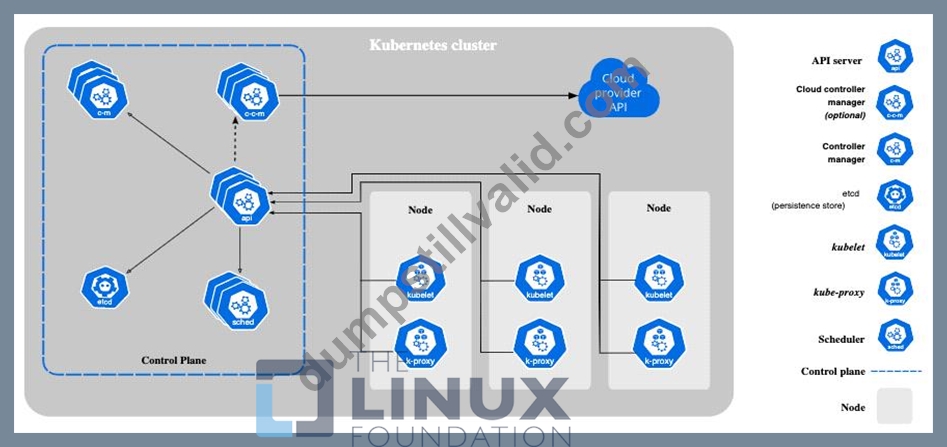
NEW QUESTION # 74
Which Kubernetes API resource is responsible for defining the structure of your Kubernetes cluster, including the number and types of nodes?
- A. Cluster
- B. pod
- C. Service
- D. Node
- E. Deployment
Answer: A
Explanation:
The Cluster resource is responsible for defining the structure of the Kubernetes cluster, including the number and types of nodes. It is a top-level resource in Kubernetes. Deployments, Services, Pods, and Nodes are all lower-level resources that are defined within a cluster.
NEW QUESTION # 75
What is the smallest possible unit in Kubernetes to run a container?
- A. container
- B. docker
- C. service
- D. pod
Answer: D
Explanation:
https://kubernetes.io/docs/concepts/workloads/pods/
NEW QUESTION # 76
You are running a production-critical application on Kubernetes. You need to ensure that if a pod fails, a new pod is automatically created to replace it. Which Kubernetes feature accomplishes this automatic pod replacement?
- A. Deployment
- B. Pod Disruption Budget (PDB)
- C. Service
- D. Namespace
- E. ReplicaSet
Answer: A
Explanation:
Deployments are Kubernetes resources designed to manage the lifecycle of pods. They provide features like rolling updates, automatic restarts, and self-healing. When a pod fails, the Deployment controller detects the failure and automatically creates a new pod to replace it, ensuring high availability.
NEW QUESTION # 77
Which of the following is NOT a key characteristic of a serverless architecture?
- A. Event-driven execution model.
- B. Pay-per-use pricing model.
- C. Automatic scaling based on workload demand
- D. Pre-provisioned and managed servers-
- E. Focus on business logic rather than infrastructure management
Answer: D
Explanation:
Serverless architectures are designed to abstract away the need for managing servers. They rely on cloud providers to handle provisioning, scaling, and infrastructure maintenance. Option C, Pre-provisioned and managed servers, contradicts the core principle of serverless computing, which is to avoid managing server infrastructure.
NEW QUESTION # 78
You are using Prometheus to monitor a Kubernetes cluster. You want to set up an alert that triggers when the average CPU usage of all nodes in the cluster exceeds 80% for the last 10 minutes. Which Prometheus query can achieve this?
- A.

- B.

- C.

- D.

- E.

Answer: A
Explanation:
The query > 0.8' calculates the average system CPU usage across all nodes over the last 10 minutes. The filter ensures that only system CPU usage is considered. If the average exceeds 0.8 (80%), the alert will trigger.
NEW QUESTION # 79
Consider the following Kubernetes pod YAML definition: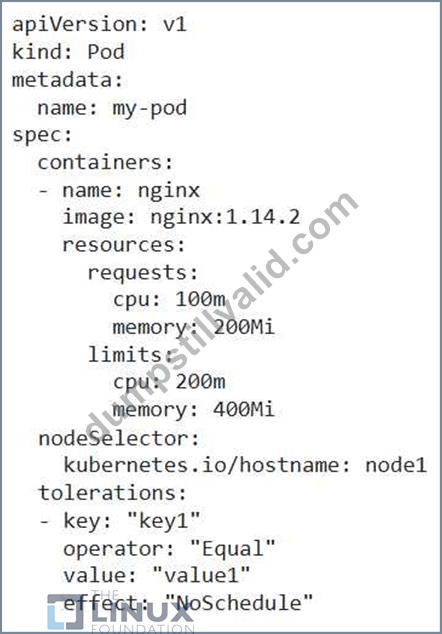
Which of the following statements is TRUE about this pod's scheduling behavior?
- A. The pod will not be scheduled on any node that has the taint *keyl: valuel: NoSchedule• , as long as the •nodeselector• condition is met.
- B. The pod will only be scheduled on a node that has at least 100m CPU and 200Mi memory available.
- C. The pod will only be scheduled on a node with the label 'kubernetes.io/hostname: nodel , regardless of available resources.
- D. The pod will only be scheduled on a node with the label 'keyl: valuel s, regardless of available resources.
- E. The pod will be scheduled on any node that meets the •nodeSelector• and •tolerations* conditions, but it may be evicted if resources become scarce.
Answer: A
Explanation:
The 'nodeselector• field instructs Kubernetes to schedule the pod ONLY on a node labeled with 'kubernetes.io/hostname: nodel*. However, the •tolerations' field specifies that the pod can tolerate a taint with the key 'keyl • , the value 'valuel • , and the effect 'NoSchedule'. This means that the pod will NOT be scheduled on a node that has that taint applied, even if the node meets the •nodeSelector• condition. The •requests' and 'limits' fields specify resource requirements for the pod, but they are not the primary factor determining the pod's scheduling in this case. The •tolerations* field takes precedence due to its 'NoSchedule• effect.
NEW QUESTION # 80
You're deploying a microservices application in a Kubernetes cluster. How can you use Jaeger for distributed tracing to troubleshoot a performance issue within the application?
- A. Configure a dedicated Jaeger deployment and configure your application to send tracing data to it.
- B. Instrument your application code to emit tracing data.
- C. Use Jaeger's IJI to visualize the tracing data and analyze request flow across different services.
- D. Deploy Jaeger as a sidecar container within each pod.
- E. Create a custom Prometheus exporter that integrates with Jaeger.
Answer: A,B,C
Explanation:
The correct answers are B, D, and E . To effectively use Jaeger for distributed tracing, you need to perform these steps: B: Instrument your application code to emit tracing data. Jaeger integrates with application code to track requests across services. It's common to use libraries like OpenTelemetry or Jaeger's client libraries to inject tracing data into your application's code. D: Configure a dedicated Jaeger deployment and configure your application to send tracing data to it. Jaeger needs its own deployment to collect and process the tracing data. You need to set up a Jaeger instance within your Kubernetes cluster and configure your application to send its tracing data to this instance. E: Use Jaeger's Ul to visualize the tracing data and analyze request flow across different services. Once the tracing data is collected, Jaeger provides a user interface to visualize the flow of requests across your microservices, identify bottlenecks, and analyze performance issues. The Jaeger UI allows you to drill down into individual traces, view the spans within a trace, and gain insights into latency, errors, and dependencies between services.
NEW QUESTION # 81
What is the name for the tool that manages communication between pods, injects a sidecar proxy container into each pod and directs network traffic through the proxy container?
- A. namespace
- B. Service mesh
- C. Network policy
- D. Service
- E. Deployment
Answer: B
NEW QUESTION # 82
You have a Kubernetes cluster with two worker nodes. One node has 8 CPU cores and 16GB RAM, while the other has 4 CPU cores and 8GB RAM. You deploy a pod with resource requests of 2 CPU cores and 4GB RAM. Where is this pod most likely to be scheduled?
- A. The node with the highest available memory capacity.
- B. The node with 8 CPU cores and 16GB RAM.
- C. Either node, as Kubernetes will randomly choose.
- D. The node with the highest available CPU capacity.
- E. The node with 4 CPU cores and 8GB RAM.
Answer: B
Explanation:
Kubernetes will try to schedule pods on nodes that have enough resources to meet the pod's requests. In this case, both nodes have enough resources, but the node with 8 CPU cores and 16GB RAM has more available resources, making it the more likely candidate for the pod to be scheduled on.
NEW QUESTION # 83
......
KCNA Premium PDF & Test Engine Files with 203 Questions & Answers: https://www.dumpstillvalid.com/KCNA-prep4sure-review.html
Current KCNA Exam Dumps [2025] Complete Linux Foundation Exam Smoothly: https://drive.google.com/open?id=12Pic_RynW7u_Yuk0LGuP1VPiKAkppehR
