


(Feb-2025) L4M5 Exam Dumps Contains FREE Real Quesions from the Actual Exam
Free Test Engine Verified By CIPS Level 4 Diploma in Procurement and Supply Certified Experts
CIPS L4M5 Certification Exam is internationally recognized and highly valued by employers. It demonstrates that you have the knowledge and skills to negotiate effectively and achieve the best possible outcomes for your organization. Commercial Negotiation certification is also a great way to enhance your credibility as a procurement professional and increase your career prospects.
NEW QUESTION # 24
Premium pricing strategies used by suppliers are characterised by which of the following? Select TWO that apply.
- A. Typically found in the early part of the product life cycle
- B. Premium price is determined by variable costs only
- C. Price is based on cost structures
- D. Products are charged at a price based on supplier's reputation
- E. This strategy is often used when supplier attempts to enter new market
Answer: A,D
Explanation:
:
There are several pricing strategies used by suppliers:
Cost-plus pricing - Total variable + Fixed cost + profit
Premium pricing - based on branding. Supplier determines to charge a very high price, not connected with cost structures, usually based on its reputation and/or the perception that the product/service is of a superior quality. This strategy typically found in the early part of the product life cycle/when demand exceeds supply.
Penetration pricing - Supplier attempts to enter a new market or extend its share in an established one. It is characterised by price reductions to increase volume, followed by steady price increases; may even be loss leading at start (no profit made) Marginal cost pricing - covers only variable cost Market pricing - suppliers prices in line with what the market is willing to pay
NEW QUESTION # 25
Which of the following are common forms of collaborating approach in Thomas-Kilmann conflict resolution model? Select THREE that apply.
- A. Yielding to another's point of view
- B. Trying to find a creative solution to current problem
- C. Trying to win at any cost
- D. Resolving some conditions that would otherwise have them competing for resources
- E. Seeking a quick middle-ground position
- F. Exploring a disagreement to learn from each other's insights
Answer: B,D,F
Explanation:
Collaborating is both assertive and cooperative. When collaborating, an individual attempts to work with the other person to find a solution that fully satisfies the concerns of both. It involves digging into an issue to identify theunderlying concerns of the two individuals and to find an alternative that meets both sets of concerns. Collaborating between two persons might take the form of exploring a disagreement to learn from each other's insights, resolving some condition that would otherwise have them competing for resources, or confronting and trying to find a creative solution to an interpersonal problem.
NEW QUESTION # 26
Which of the following is most likely a consequence of falling interest rate?
- A. Increase aggregate demand
- B. Decrease investment
- C. Increase savings
- D. Decrease consumption
Answer: A
Explanation:
:
If interest rate are too low and credit is too, cheap rates can fund a spending boom with consumers and businesses buying (investment) more than they can afford to pay back.
NEW QUESTION # 27
In a detailed cost breakdown, a company has a salary cost of 9%, raw materials cost 51% and overheads cost
24%. Which of the following represents themark-up of that company?
- A. Approximately 19%
- B. Approximately 116%
- C. Approximately 16%
- D. Approximately 84%
Answer: A
Explanation:
Explanation
Mark-up is the amount added to the cost of an item to get to its selling price and is expressed as a percentage.
Mark-up(%) = (Price - Cost) / Cost x 100
= (100 - 9 - 51 - 24) / (9 +51 +24) x 100 = 16 / 84 x 100 = 19.04%
LO 2, AC 2.1
NEW QUESTION # 28
Which of the following should be the final step of a negotiation process if both parties cannot reach an agreement?
- A. Reflecting on performance
- B. Celebrating publicly about the deal
- C. Tempting TOP to reopen the negotiation
- D. Asking TOP for another concession
Answer: A
Explanation:
Reflecting on performance should become a natural final step in the negotiation process.
'Celebrating publicly about the deal': Public gloating, even in success or failure, if it gets back to the supplier via the press or social media, will likely damage the relationship
'Tempting TOP to reopen the negotiation': whether TOP agrees to reopen the negotiation, procurement should reflect on their achievement and what can be improved.
'Asking TOP for another concession': TOP can agree or reject this concession. Eventually, reflecting should be the final step. Procurement can learn a lot from reflection on performance.
LO 3, AC 3.4
NEW QUESTION # 29
Which of the following are effective approaches when procurement professionals negotiate with monopoly suppliers?
1. Delaying payment with monopoly suppliers as long as possible to increase bargaining power
2. Setting up stronger BATNA
3. Engaging in the negotiation with a distributive approach
4. Eliminating requirements in the specification that prioritises monopoly suppliers
- A. 3 and 4 only
- B. 1 and 4 only
- C. 2 and 3 only
- D. 2 and 4 only
Answer: D
Explanation:
In most commercial negotiations with monopolistic organisations, one can expect that in general they will have far greater bargaining power - you will need them more than they need you. There BATNA isstronger in the short run, but over time their power can be challenged effectively.
Ways of dealing with monopoly suppliers include the following:
Making yourself an attractive buyer
Seeking out alternatives / substitutes in a private or public manner
Designing out the requirement that forces you to go to the monopoly suppliers, or seek to make the product, or threaten to make it yourself if feasible Lobbying government or campaigning, as part of an industry or trade body, for a reduction in barriers to entry that support the monopoly
NEW QUESTION # 30
Which of the following may help the procurement professional increase expert power in commercial negotiation? Select TWO that apply.
- A. Personality
- B. Official positions
- C. Expertise knowledge
- D. Ability to compensation
- E. Insights
Answer: C,E
Explanation:
:
Expert power is based on a person's high levels of skill and knowledge, formal training, qualifications and experience in a particular procurement category would give someone expert status and mean that in negotiation their voice is listened to as a more objective, informed knowledge leader. Expert power is based on facts, knowledge, research, insight and study.
Legitimate power comes from rules, formal authority, organisation rank, staff rate or official position held.
Reward power comes from one person's ability to compensate or reward another for compliance.
Referent power stems from their personality, way of engaging with others and habit of acting in a way that is in line with a strong set of values and principles.
NEW QUESTION # 31
Katie is preparing a negotiation with a strategic supplier. Through deep market analysis, she realises that her company and the supplier have equal bargaining power. Via regular communication, Katie knows that both parties are arguing on amount of liquidated damages and neither party shall concede all of their requirements but some are negotiable. Katie and her counterpart from supplying company still desire a long-term relationship and hope that the meeting between them will be a solution for current situation. Which of the following is the most appropriate approach that Katie should adopt to achieve the above outcome?
- A. Accommodating approach
- B. Avoiding approach
- C. Competing approach
- D. Compromising approach
Answer: D
Explanation:
Competing is assertive and uncooperative, a power-oriented mode. When competing, an individual pursues his or her own concerns at the other person's expense, using whatever power seems appropriate to win his or her position. Competing might mean standing up for your rights, defending a position you believe is correct, or simply trying to win. Competing will not allow long-term relationship to flourish.
Compromising is intermediate in both assertiveness and cooperativeness. When compromising, the objective is to find an expedient, mutually acceptable solution that partially satisfies both parties. Compromising falls on a middle ground between competing and accommodating, giving up more than competing but less than accommodating. Likewise, it addresses an issue more directly than avoiding but doesn't explore it in as much depth as collaborating. Compromising might mean splitting the difference, exchanging concessions, or seeking a quick middle-ground position. It is a valid approach when long-term relationships are at stake and it is important to find some common ground on which to base an agreement. Both sides get something but not everything. Therefore, this is the most appropriate for this scenario.
Avoiding is unassertive and uncooperative. When avoiding, an individual does not immediately pursue his or her own concerns or those of the other person. He or she does not address the conflict. Avoiding might take the form of diplomatically sidestepping an issue, postponing an issue until a better time, or simply withdrawing from a threatening situation. In the scenario, both parties want to take the opportunity, then avoiding is not an appropriate solution.
Accommodating is unassertive and cooperative-the opposite of competing. When accommodating, an individual neglects his or her own concerns to satisfy the concerns of the other person; there is an element of self-sacrifice in this mode. Accommodating might take the form of selfless generosity or charity, obeying another person's order when you would prefer not to, or yielding to another's point of view. In the scenario, neither party shall concede all of their requirements, it is unnecessary to adopt this approach.
LO 1, AC 1.1
NEW QUESTION # 32
Which of the following are most likely to be characteristics of a perfectly competitive market? Select TWO that apply
- A. In a competitive market, both buyers and sellers areprice givers
- B. In a perfectly competitive market, each seller has a large impact on the market price A perfectly competitive market consists of products that are all slightly different from one another
- C. There are many buyers and sellers in the market
- D. Firms can freely enter or exit the market
Answer: C,D
Explanation:
Explanation
A perfectly competitive market is one with the following features:
- There are many firms producing identical or very similar (homogeneous) goods or services
- There are no barriers toentry to the market or exit from the market - anyone can enter or leave easily
- Both producers and customers have perfect knowledge of the market place, prices, costs of production and influences on demand and supply Under these conditions, the price andquantity will always tend toward equilibrium as any producer that sets a price above equilibrium will not sell anything at all, and any producer that sets a price below a equilibrium will obtain 100% market share in theory. The demand curve is perfectly elastic, which means that it will be horizontal. In a perfectly competitive market, it is difficult to increase profits through pricing, and suppliers instead must focus on their cost structure. As these conditions imply, there are few if any examples of perfectly competitive market.
LO 2, AC 2.2
NEW QUESTION # 33
Which of the following are most likely to be fundamentals of Fisher & Ury's principled negotiation?
1. Depersonalise the argument
2. Focus on positions
3. Generate creative options
4. Using subjective criteria
- A. 1 and 3 only
- B. 2 and 4 only
- C. 1 and 4 only
- D. 2 and 3 only
Answer: A
Explanation:
Principled negotiation is based on four fundamentals: people, interest, options and criteria:
Diagram Description automatically generated
1st Principle: separate the people from the problem: Negotiator should depersonalise the situation and accepting that the subject matter of the negotiation. This can be difficult for untrained negotiators, but this is a key skill to develop
2nd principle: focus on interests, not positions: It is important in principled negotiations not to focus on their parties' positions (what are expressed during negotiations), but on the interests (underlying needs) behind them
3rd principle: invent options for mutual gains: this principle aims to help the parties find a solution that both would benefit from. The more options - or tradeables - that can be brought to the table the better.
4th principle: insist on using objective criteria: is about making sure that the negotiation stays focused on outcomes based on objective criteria and that it is productive.
LO 1, AC 1.2
NEW QUESTION # 34
A procurement manager has been asked to procure 1,000 pens. He suggests to his manager that to obtain the best value for money, they should undertake a competitive bidding process. Would this be the best course of action?
- A. No, competitive bidding should only be used when the value justifies the time spent on the process
- B. Yes, the process will be opened up to many suppliers and therefore will result in a cheaper price for the pens
- C. No, competitive bidding should only be used in public sector organisations
- D. Yes, as all procurement processes should go through competitive bidding to achieve the best value for money
Answer: A
Explanation:
Competitive bidding is generally recommended for high-value or complex purchases where the cost and time required for the bidding process are justified. For low-value, routine items like pens, the time and resources required for competitive bidding may outweigh the potential cost savings, as noted in CIPS best practices.
Hence, Option C is the best answer.
NEW QUESTION # 35
Which of the following are most likely to be sources of conflict that can emerge from the process of commercial negotiations? Select TWO that apply.
- A. Types of purchase
- B. Differences in conflict management style
- C. Standard terms and conditions
- D. Line of the best fits
- E. Differences in culture
Answer: B,E
Explanation:
There are multiple sources of divergent positions that can arise in situations where money is exchange for goods and services. There are 2 different types of sources. Those that arise from the content or subject matter of the negotiation (what is being negotiated) and those that arise from the process of negotiation (how it is being negotiated).
Sources of divergent positions - the process of negotiation:
Table Description automatically generated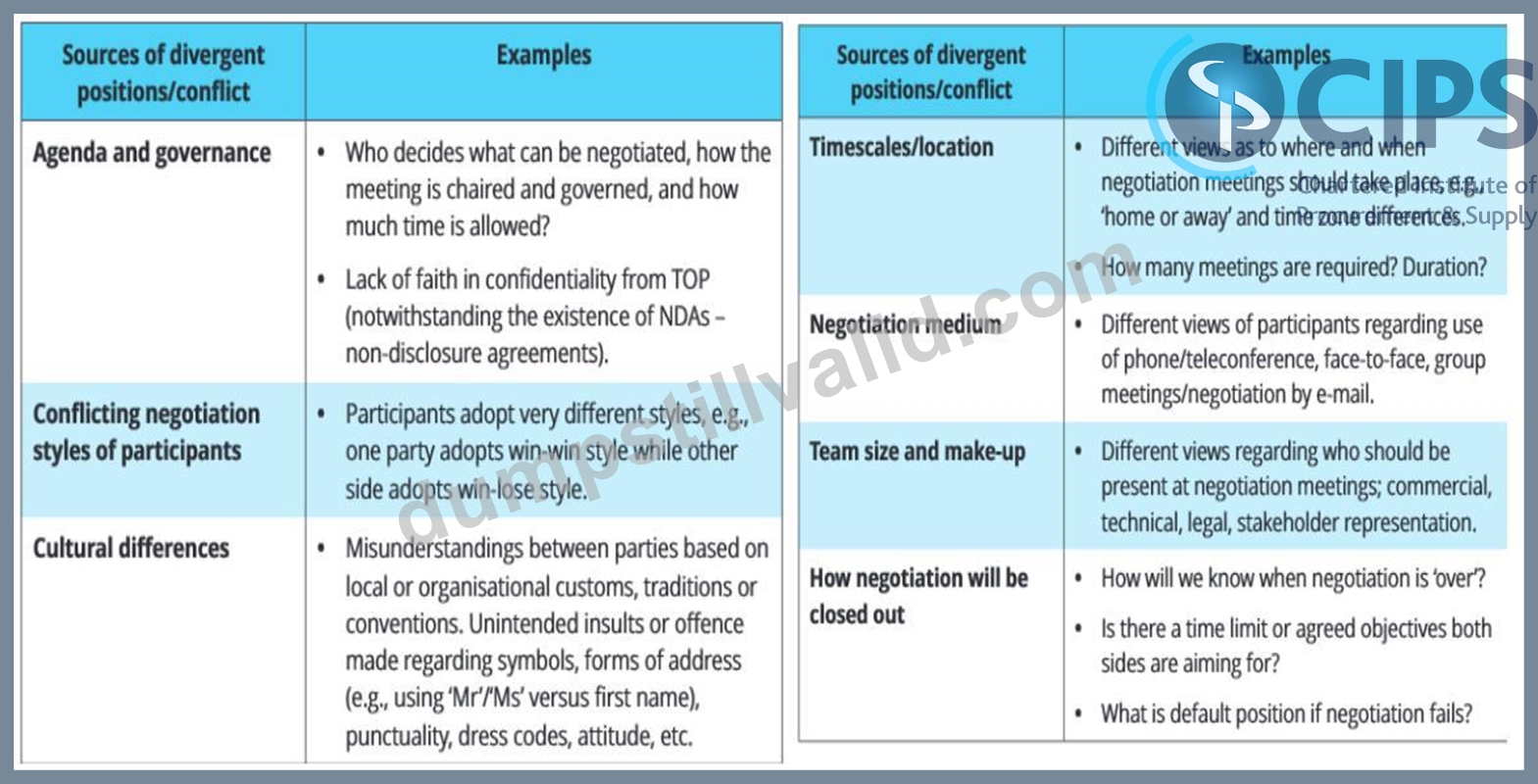
Line of best fits is the line that goes approximately through the middle of the data points with an equal number of data points above and below it. Line of best fits is a method of calculating medium value instatistics.
Standard terms and conditions are basic terms and conditions of business governing transactions that do not have a definitive contract, usually designed to be included in form documents such as orders. While there may be conflicts regarding standard terms and conditions, they are about the content of negotiation, not the process.
Type of purchase: when buying organisation makes an decision to purchase an item, a buyer is faced with three possible scenarios. The item to be bought could be a straight re-buy, a modified re-buy or a new purchase. Decision on type of purchase is purely an internal decision.
NEW QUESTION # 36
Hammad Alsuwaidi is a procurement professional leading a negotiation for a vehicle rental contract. Hammad has a clear goal to negotiate a two-year contract in exchange for a minimum of a 20% discount. During the negotiation, Hammad presents to the supplier the facts, figures, and justification for a 20% discount. Which of the persuasion methods below has Hammad chosen?
- A. Collaborative
- B. Pull
- C. Visionary
- D. Push
Answer: D
Explanation:
Hammad's approach of presenting facts, figures, and justifications aligns with the Push persuasion method.
The Push strategy involves directly presenting information, data, and logical arguments to convince the other party of a certain outcome. In this scenario, Hammad is using objective evidence to influence the supplier towards agreeing to a discount, which is characteristic of the Push method, as per CIPS guidance on negotiation tactics.
NEW QUESTION # 37
Which of the following are behaviours that builds trust between the buyer and the supplier in business relationship? Select TWO that apply.
- A. Commercial espionage
- B. Tendency to blame other party
- C. Conducting transparent procurement process
- D. Over-inflated contingency funds
- E. Allowing supplier to involve in early product development
Answer: C,E
Explanation:
:
Trust-building behaviours are as following:
Joint-effort issue resolution
Open sharing of information
Open and honest discussion on root cause of failures
Joint planning focusing on value for money and risk sharing
Commercial transparency and co-proposition of cost reduction and service improvement programmes Joint recognition and celebration of successes
NEW QUESTION # 38
Where can we find the data on macroeconomics?
1. From trade journal
2. From supplier's marketing catalogue
3. From stock exchange market
4. From government's statistics
- A. 2 and 4 only
- B. 3 and 4 only
- C. 1 and 3 only
- D. 1 and 2 only
Answer: B
Explanation:
Explanation
Macroeconomic indicators are statistics or data readings that reflect the economic circumstances of a particular country, region or sector. They are used by analysts and governments to assess the current and future health of the economy and financial markets.
Macroeconomic indicators will vary in their meaning and the impact that they have on the economy, but broadly speaking there are two main types of indicator.
- Leading indicators, which forecast where an economy might be heading. They are often used by governments to implement policies because they represent the first phase of a new economic cycle. These include the yield curve, interest rates and share prices.
- Lagging indicators, which reflect an economy's historical performance and only change after a trend has been established. They are used to confirm a trend is underway. These include gross domestic product (GDP), inflation and employment figures.
There is also the category of coincident indicators, but these are generally grouped in with lagging indicators as they either happen at the same time or after an economic shift.
The best macroeconomic indicator to watch will heavily depend on your personal preferences, what positions you are taking and which country your portfolio is focused on. However, there are some very common indicators that most traders and investors will keep an eye on.
For simplicity's sake, we have split these out into leading and lagging indicators.
Top leading indicators:
1. The stock market
2. House prices
3. Bond yields
4. Production and manufacturing statistics
5. Retail sales
6. Interest rates
Top laggingindicators:
1. GDP growth rates
2. The Consumer Price Index (CPI) and inflation
3. Currency strength and stability
4. Labour market statistics
5. Commodity prices
A procurement professional may find stock market data from the security exchange, whilemost lagging indicators (such as GDP, CPI, unemployment rate, currency and inflation rate, etc) can be found from government statistics data.
NEW QUESTION # 39
Which of the following is most likely a consequence of falling interest rate?
- A. Increase aggregate demand
- B. Decrease investment
- C. Increase savings
- D. Decreaseconsumption
Answer: A
Explanation:
If interest rate are too low and credit is too, cheap rates can fund a spending boom with consumers and businesses buying (investment) more than they can afford to pay back.
NEW QUESTION # 40
What is the most likely outcome when two organisations with adversarial relationship negotiate with each other?
- A. Deadlocked
- B. Win win
- C. Lose lose
- D. Win lose
Answer: D
Explanation:
:
An adversarial relationship in purchasing and supply arises when identical or equivalent good or services are available from competing suppliers and buyers/sellers are trying to gain an advantage over each other. Low levels of trust are characteristic of adversarial relationships. The outcome when two organisations with adversarial negotiate is most likely to be win-lose.
NEW QUESTION # 41
Which of the following is the first step in the development of negotiation strategies?
- A. Determining your BATNA
- B. Developing scenarios around possible options
- C. Recognising TOP's needs and wants
- D. Defining overarching objectives
Answer: D
Explanation:
:
Developing specific negotiation strategies in areas where risk or spend is high involves analysing a wide range of objectives and variables within the context of the organisation's business requirements. The first stage in any negotiation preparation is to define your overall objectives which may be related to a single variable such as price in the case of a standardised requirement, or many variables in the case of capital equipment. Your negotiating strategies and tactics will all be focused on achieving overall objectives.
NEW QUESTION # 42
Which of the following should be done when undertaking a reflection activity on negotiation? Select TWO that apply.
- A. Identify areas in your skill set where you need to improve
- B. Be overly modest about your contribution to the outcomes of negotiation
- C. Gloss over areas where you need to improve your skills or performance
- D. Use generalised or ambiguous language when describing your strengths and development areas
- E. Be honest and objective about your skills
Answer: A,E
Explanation:
Giving positive group and individual feedback is easy, as is self-congratulation and, in many cases, it is hoped, this will be an accurate reflection on actual performance. When it comes to developmental or difficult feedback, it is only natural to want to move on and not reflect on the negative or developmental points, or why a negotiation did not achieve its objectives. But this is a mistake. The best learning opportunities come from reflection on what could be done better, and this can beachieved without blame, threat or condemnation.
Everyone and every team will make mistakes and/or have areas where they could have improved. Clearly, if every reflection session concludes that an individual or team keeps making the same mistake, then thereis a case to change roles or consider alternative approaches.
About Dos and Don'ts of reflection, you can refer here:
https://offices.depaul.edu/human-resources/employee-relations/Documents/Self%20Assesement.pdf
NEW QUESTION # 43
......
Use Real CIPS Achieve the L4M5 Dumps - 100% Exam Passing Guarantee: https://www.dumpstillvalid.com/L4M5-prep4sure-review.html
Verified L4M5 Q&As - Pass Guarantee L4M5 Exam Dumps: https://drive.google.com/open?id=1h4DM7dpJoIbdCB4CzM5Ut9BYMwBKcNNO
