


AZ-220 Training & Certification Get Latest Microsoft Certified: Azure IoT Developer Specialty Updated on Dec 27, 2021
Certification Training for AZ-220 Exam Dumps Test Engine
Wrapping up
IoT is a promising field in the IT sector and the Microsoft AZ-220 test acts as an ideal launching pad for this path since such an exam throws light on every essential skill of this subject matter. While you aim at it, don’t overlook the need of referring to updated study materials like official training offered by the vendor.
NEW QUESTION 51
You have the following device twin for the IoT device.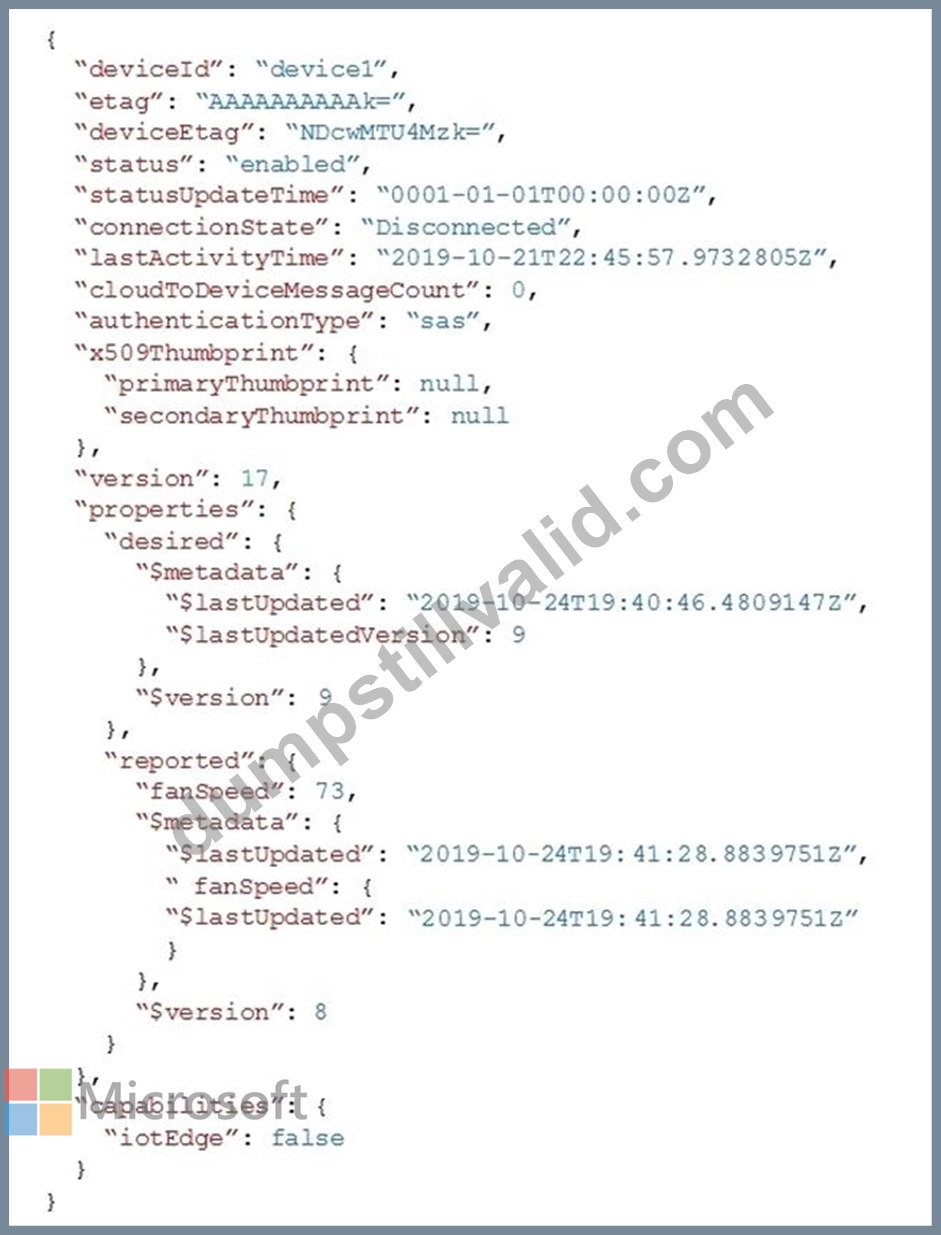
For each of the following statements, select Yes if the statement is true. Otherwise, select No.
NOTE: Each correct selection is worth one point.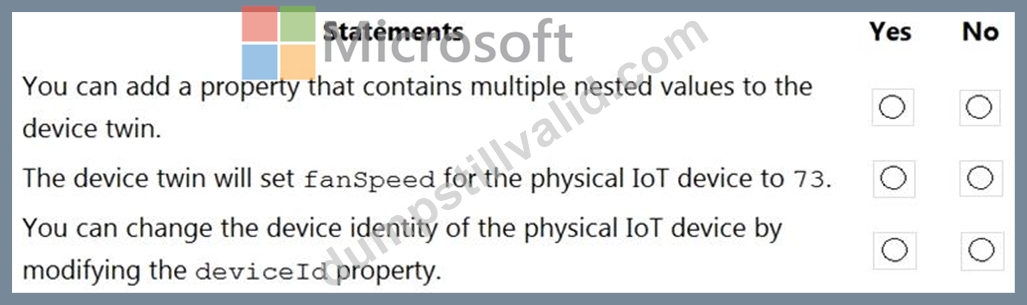
Answer:
Explanation: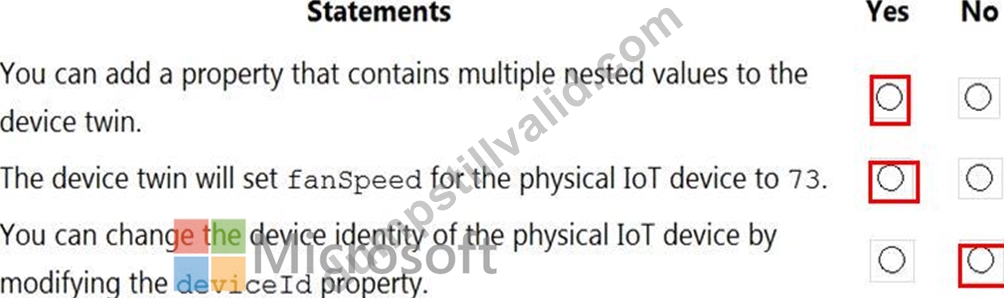
Explanation:
Box1: Yes
Box 2: Yes
Fanspeed 73 is a reported property.
Box 3: No
The deviceID property is read only.
Reference:
https://docs.microsoft.com/en-us/azure/iot-hub/iot-hub-devguide-device-twins
NEW QUESTION 52
You have an Azure IoT hub.
You plan to implement IoT Hub events by using Azure Event Grid.
You need to send an email when the following events occur:
* Device Created
* Device Deleted
* Device Connected
* Device Disconnected
Which two actions should you perform? Each correct answer presents part of the solution.
NOTE: Each correct selection is worth one point.
- A. From the IoT hub, configure an event subscription that has Web Hook as the Endpoint Type.
- B. From the IoT hub, configure an event subscription that has API management as the Endpoint Type.
- C. Create an Azure logic app that has a Request trigger.
- D. From the IoT hub, configure an event subscription that has Service Bus Queue as the Endpoint Type.
Answer: A,C
Explanation:
For non-telemetry events like DeviceConnected, DeviceDisconnected, DeviceCreated and DeviceDeleted, the Event Grid filtering can be used when creating the subscription.
C: Azure Event Grid enables you to react to events in IoT Hub by triggering actions in your downstream business applications.
A trigger, such as a Request trigger, is a specific event that starts your logic app.
Reference:
https://docs.microsoft.com/en-us/azure/event-grid/publish-iot-hub-events-to-logic-apps
NEW QUESTION 53
You have an Azure IoT solution that includes several Azure IoT hubs.
A new alerting feature was recently added to the IoT devices. The feature uses a new device twin reported property named alertCondition.
You need to send alerts to an Azure Service Bus queue named MessageAlerts. The alerts must include alertCondition and the name of the IoT hub.
Which two actions should you perform? Each Answer presents part of the solution.
NOTE: Each correct selection is worth one point.
- A. Add the following message enrichments:
Name = iotHubName
Value = $twin.tag.location
Endpoint = MessageAlert - B. Configure File upload for each IoT hub. Configure the device to send a file to an Azure Storage container that contains the device name and status message.
- C. Create an IoT Hub routing rule that has a data source of Device Telemetry Messages and select the endpoint for MessageAlerts.
- D. Create an IoT Hub routing rule that has a data source of Device Twin Change Events and select the endpoint for MessageAlerts.
- E. Add the following message enrichments:
Name = iotHubName Value = $iothubname
Endpoint = MessageAlert
Answer: A,E
Explanation:
B: Message enrichments is the ability of the IoT Hub to stamp messages with additional information before the messages are sent to the designated endpoint. One reason to use message enrichments is to include data that can be used to simplify downstream processing. For example, enriching device telemetry messages with a device twin tag can reduce load on customers to make device twin API calls for this information.
D: Applying enrichments
The messages can come from any data source supported by IoT Hub message routing, including the following examples:
-->device twin change notifications -- changes in the device twin device telemetry, such as temperature or pressure device life-cycle events, such as when the device is created or deleted Reference:
https://docs.microsoft.com/en-us/azure/iot-hub/iot-hub-message-enrichments-overview
NEW QUESTION 54
Note: This question is part of a series of questions that present the same scenario. Each question in the series contains a unique solution that might meet the stated goals. Some question sets might have more than one correct solution, while others might not have a correct solution.
After you answer a question in this section, you will NOT be able to return to it. As a result, these questions will not appear in the review screen.
You have devices that connect to an Azure IoT hub. Each device has a fixed GPS location that includes latitude and longitude.
You discover that a device entry in the identity registry of the IoT hub is missing the GPS location.
You need to configure the GPS location for the device entry. The solution must prevent the changes from being propagated to the physical device.
Solution: You add the desired properties to the device twin.
Does the solution meet the goal?
- A. No
- B. Yes
Answer: A
Explanation:
Instead add tags to the device twin. Desired properties are synced, while tags are not.
Incorrect Answers:
A: Device Twins are used to synchronize state between an IoT solution's cloud service and its devices. Each device's twin exposes a set of desired properties and reported properties. The cloud service populates the desired properties with values it wishes to send to the device. When a device connects it requests and/or subscribes for its desired properties and acts on them.
Reference:
https://docs.microsoft.com/de-de/azure/iot-hub/iot-hub-devguide-device-twins
https://azure.microsoft.com/sv-se/blog/deep-dive-into-azure-iot-hub-notifications-and-device-twin/
NEW QUESTION 55
You need to add Time Series Insights to the solution to meet the pilot requirements.
Which three actions should you perform in sequence? To answer, move the appropriate actions from the list of actions to the answer area and arrange them in the correct order.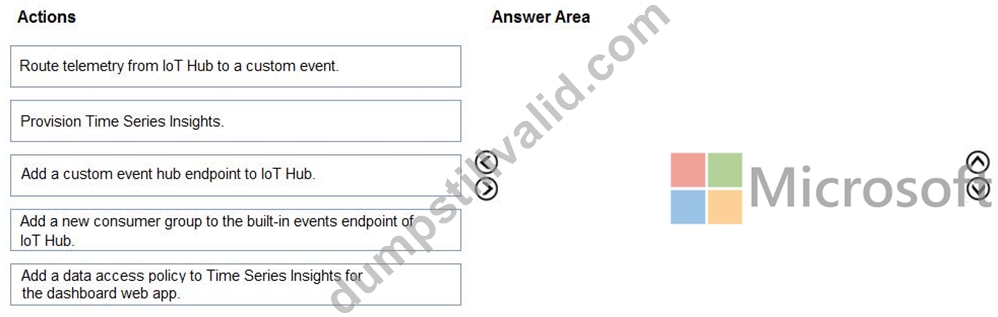
Answer:
Explanation: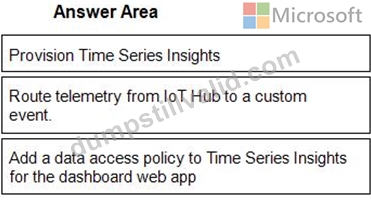
1 - Provision Time Series Insights
2 - Route telemetry from IoT Hub to a custom event.
3 - Add a data access policy to Time Series Insights for the dashboard web app Reference:
https://docs.microsoft.com/en-us/azure/time-series-insights/time-series-insights-update-create-environment
NEW QUESTION 56
Note: This question is part of a series of questions that present the same scenario. Each question in the series contains a unique solution that might meet the stated goals. Some question sets might have more than one correct solution, while others might not have a correct solution.
After you answer a question in this section, you will NOT be able to return to it. As a result, these questions will not appear in the review screen.
You have 20 IoT devices deployed across two floors of a building. The devices on the first floor must be set to 60 degrees. The devices on the second floor must be set to 80 degrees.
The device twins are configured to use a tag that identifies the floor on which the twins are located.
You create the following automatic configuration for the devices on the first floor.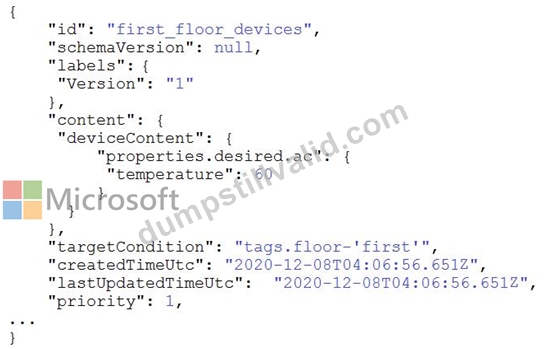
You create the following automatic configuration for the devices on the second floor.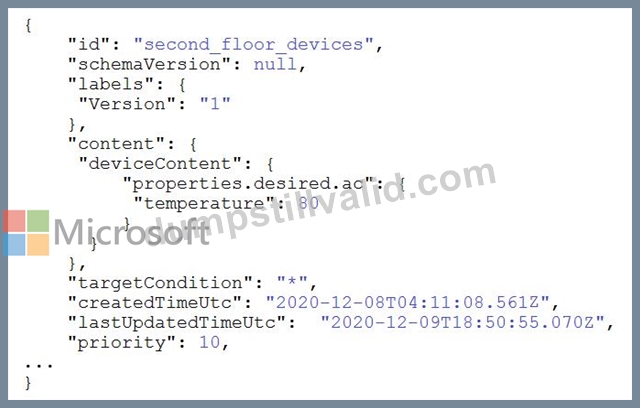
The IoT devices on the first floor report that the temperature is set to 80 degrees.
You need to ensure that the first-floor devices are set to the correct temperature.
Solution: In the automatic configuration for the second-floor devices, you set Version to 2.
Does this meet the goal?
- A. No
- B. Yes
Answer: A
Explanation:
Reference:
https://docs.microsoft.com/en-us/azure/iot-edge/module-deployment-monitoring?view=iotedge-2020-11
https://docs.microsoft.com/en-us/azure/iot-hub/iot-hub-automatic-device-management-cli
NEW QUESTION 57
Note: This question is part of a series of questions that present the same scenario. Each question in the series contains a unique solution that might meet the stated goals. Some question sets might have more than one correct solution, while others might not have a correct solution.
After you answer a question in this section, you will NOT be able to return to it. As a result, these questions will not appear in the review screen.
You have an Azure Stream Analytics job that receives input from an Azure IoT hub and sends the outputs to Azure Blob storage. The job has compatibility level 1.1 and six streaming units.
You have the following query for the job.
You plan to increase the streaming unit count to 12.
You need to optimize the job to take advantage of the additional streaming units and increase the throughput.
Solution: You change the query to the following.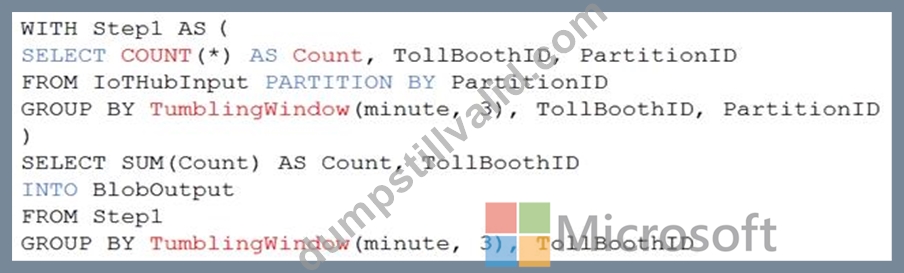
Does this meet the goal?
- A. No
- B. Yes
Answer: B
Explanation:
Max number of Streaming Units with one step and with no partitions is 6.
Reference:
https://docs.microsoft.com/en-us/azure/stream-analytics/stream-analytics-parallelization
NEW QUESTION 58
Note: This question is part of a series of questions that present the same scenario. Each question in the series contains a unique solution that might meet the stated goals. Some question sets might have more than one correct solution, while others might not have a correct solution.
After you answer a question in this question, you will NOT be able to return to it. As a result, these questions will not appear in the review screen.
You have an Azure IoT solution that includes an Azure IoT hub, a Device Provisioning Service instance, and
1,000 connected IoT devices.
All the IoT devices are provisioned automatically by using one enrollment group.
You need to temporarily disable the IoT devices from the connecting to the IoT hub.
Solution: From the IoT hub, you change the credentials for the shared access policy of the IoT devices.
Does the solution meet the goal?
- A. No
- B. Yes
Answer: A
Explanation:
Explanation/Reference:
https://docs.microsoft.com/bs-latn-ba/azure/iot-dps/how-to-unprovision-devices
NEW QUESTION 59
You have 1,000 devices that connect to a standard tier Azure IoT hub.
All the devices are commissioned and send telemetry events to the built-in IoT Hub endpoint. You configure message enrichment on the events endpoint and set the enrichment value to$twin.tags.ipV4.
When you inspect messages on the events endpoint, you discover that all the messages are stamped with a string of "$twin.tags.ipV4".
What are two possible causes of the issue? Each Answer presents a complete solution.
NOTE: Each correct selection is worth one point.
- A. A standard tier IoT hub does not support device twin properties in message enrichments.
- B. The ipV4 tag is a restricted twin property that is unavailable for message enrichment.
- C. Message enrichment cannot be added to messages going to a built-in endpoint.
- D. The device twin property value used for message enrichment is set to "$twin.tags.ipV4".
- E. The device twin path used for the value of the enrichment does not exist.
- F. The device sending the message has no device twin.
Answer: E,F
Explanation:
In some cases, if you are applying an enrichment with a value set to a tag or property in the device twin, the value will be stamped as a string value. For example, if an enrichment value is set to $twin.tags.field, the messages will be stamped with the string "$twin.tags.field" rather than the value of that field from the twin. This happens in the following cases:
(C) Your IoT Hub is in the standard tier, but the device sending the message has no device twin.
(E) Your IoT Hub is in the standard tier, but the device twin path used for the value of the enrichment does not exist. For example, if the enrichment value is set to $twin.tags.location, and the device twin does not have a location property under tags, the message is stamped with the string "$twin.tags.location".
Your IoT Hub is in the basic tier. Basic tier IoT hubs do not support device twins.
Reference:
https://docs.microsoft.com/en-us/azure/iot-hub/iot-hub-message-enrichments-overview
NEW QUESTION 60
Note: This question is part of a series of questions that present the same scenario. Each question in the series contains a unique solution that might meet the stated goals. Some question sets might have more than one correct solution, while others might not have a correct solution.
After you answer a question in this question, you will NOT be able to return to it. As a result, these questions will not appear in the review screen.
You have an Azure IoT solution that includes an Azure IoT hub, a Device Provisioning Service instance, and 1,000 connected IoT devices.
All the IoT devices are provisioned automatically by using one enrollment group. You need to temporarily disable the IoT devices from the connecting to the IoT hub.
Solution: From the IoT hub, you change the credentials for the shared access policy of the IoT devices. Does the solution meet the goal?
- A. No
- B. Yes
Answer: A
Explanation:
Reference:
https://docs.microsoft.com/bs-latn-ba/azure/iot-dps/how-to-unprovision-devices
NEW QUESTION 61
You have 100 devices that connect to an Azure IoT hub.
You need to be notified about failed local logins to a subnet of the devices.
Which three actions should you perform in sequence? To answer, move the appropriate actions from the list of actions to the answer area and arrange them in the correct order.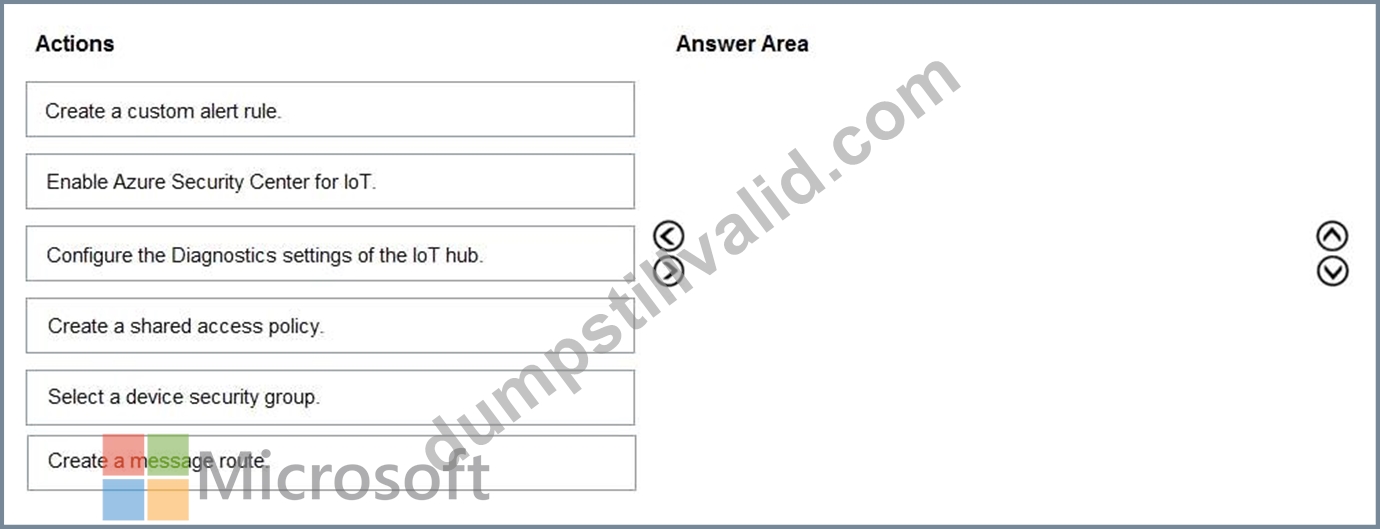
Answer:
Explanation: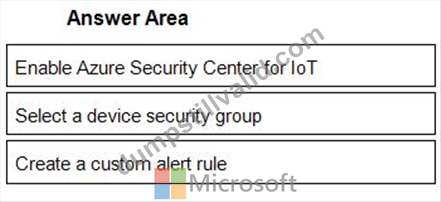
1 - Enable Azure Security Center for IoT
2 - Select a device security group
3 - Create a custom alert rule
Reference:
https://docs.microsoft.com/bs-latn-ba/azure/asc-for-iot/how-to-security-data-access
https://docs.microsoft.com/en-us/rest/api/securitycenter/devicesecuritygroups/createorupdate
NEW QUESTION 62
HOTSPOT
You have an Azure IoT hub.
You plan to deploy 1,000 IoT devices by using automatic device management.
The device twin is shown below.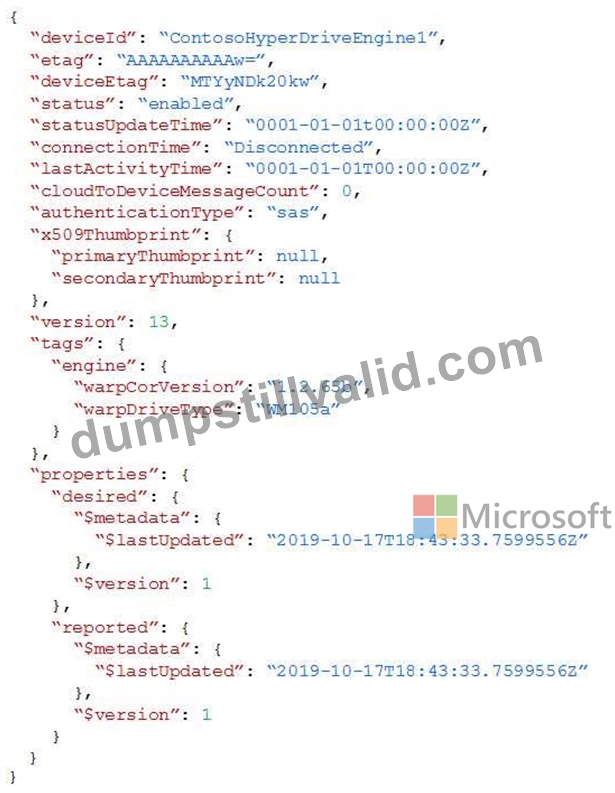
You need to configure automatic device management for the deployment.
Which target Condition and Device Twin Path should you use? To answer, select the appropriate options in the answer area.
NOTE: Each correct selection is worth one point.
Hot Area: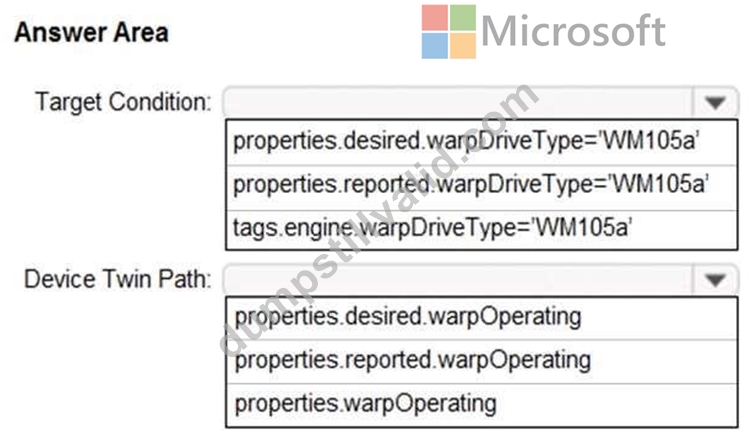
Answer:
Explanation: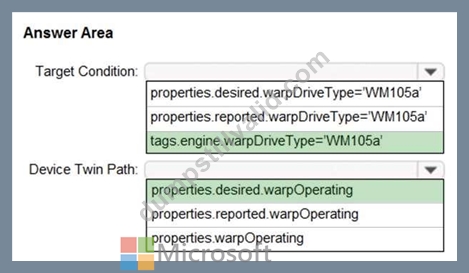
Explanation:
Box 1: tags.engine.warpDriveType='VM105a'
Use tags to target twins. Before you create a configuration, you must specify which devices or modules you want to affect. Azure IoT Hub identifies devices and using tags in the device twin, and identifies modules using tags in the module twin.
Box 2: properties.desired.warpOperating
The twin path, which is the path to the JSON section within the twin desired properties that will be set.
For example, you could set the twin path to properties.desired.chiller-water and then provide the following JSON content:
{
"temperature": 66,
"pressure": 28
}
Reference:
https://docs.microsoft.com/en-us/azure/iot-hub/iot-hub-automatic-device-management Provision and manage devices Testlet 1 Case Study This is a case study. Case studies are not timed separately. You can use as much exam time as you would like to complete each case. However, there may be additional case studies and sections on this exam. You must manage your time to ensure that you are able to complete all questions included on this exam in the time provided.
To answer the questions included in a case study, you will need to reference information that is provided in the case study. Case studies might contain exhibits and other resources that provide more information about the scenario that is described in the case study. Each question is independent of the other question on this case study.
At the end of this case study, a review screen will appear. This screen allows you to review your answers and to make changes before you move to the next sections of the exam. After you begin a new section, you cannot return to this section.
To start the case study
To display the first question on this case study, click the Next button. Use the buttons in the left pane to explore the content of the case study before you answer the questions. Clicking these buttons displays information such as business requirements, existing environment, and problem statements. If the case study has an All Information tab, note that the information displayed is identical to the information displayed on the subsequent tabs. When you are ready to answer a question, click the Question button to return to the question.
Existing Environment. Current State of Development
Contoso produces a set of Bluetooth sensors that read the temperature and humidity. The sensors connect to IoT gateway devices that relay the data.
All the IoT gateway devices connect to an Azure IoT hub named iothub1.
Existing Environment. Device Twin
You plan to implement device twins by using the following JSON sample.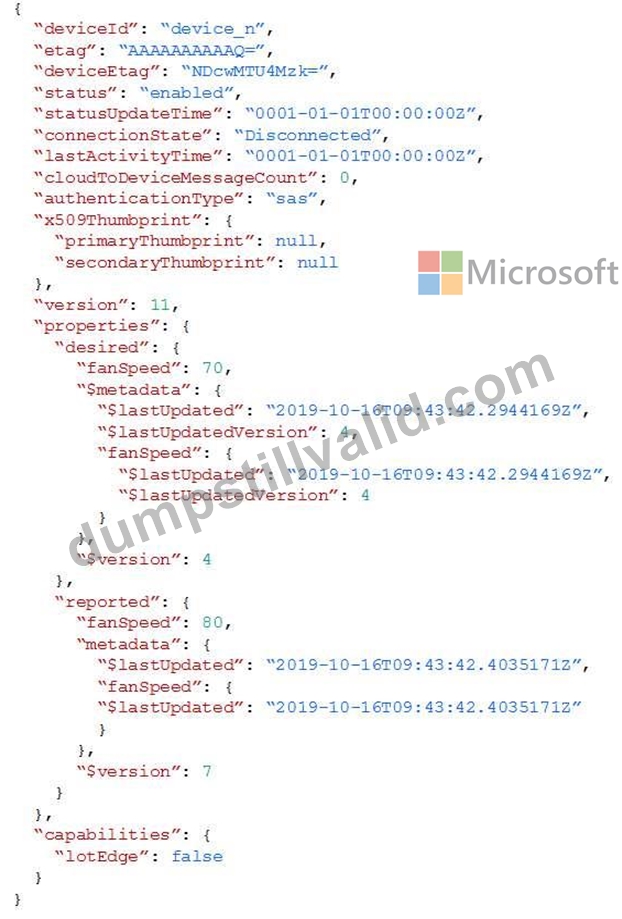
Existing Environment. Azure Stream Analytics
Each room will have between three to five sensors that will generate readings that are sent to a single IoT gateway device. The IoT gateway device will forward all the readings to iothub1 at intervals of between 10 and
60 seconds.
You plan to use a gateway pattern so that each IoT gateway device will have its own IoT Hub device identity.
You draft the following query, which is missing the GROUP BYclause.
SELECT
AVG(temperature),
System.TimeStamp() AS AsaTime
FROM
Iothub
You plan to use a 30-second period to calculate the average temperature reading of the sensors.
You plan to minimize latency between the condition reported by the sensors and the corresponding alert issued by the Stream Analytics job.
Existing Environment. Device Messages
The IoT gateway devices will send messages that contain the following JSON data whenever the temperature exceeds a specified threshold.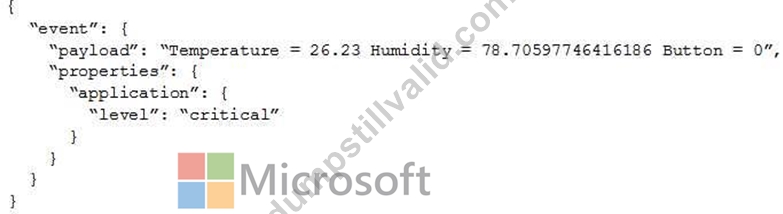
The levelproperty will be used to route the messages to an Azure Service Bus queue endpoint named criticalep.
Existing Environment. Issues
You discover connectivity issues between the IoT gateway devices and iothub1, which cause IoT devices to lose connectivity and messages.
Requirements. Planning Changes
Contoso plans to make the following changes:
* Use Stream Analytics to process and view data.
* Use Azure Time Series Insights to visualize data.
* Implement a system to sync device statuses and required settings.
* Add extra information to messages by using message enrichment.
* Create a notification system to send an alert if a condition exceeds a specified threshold.
* Implement a system to identify what causes the intermittent connection issues and lost messages.
Requirements. Technical Requirements
Contoso must meet the following requirements:
* Use the built-in functions of IoT Hub whenever possible.
* Minimize hardware and software costs whenever possible.
* Minimize administrative effort to provision devices at scale.
* Implement a system to trace message flow to and from iothub1.
* Minimize the amount of custom coding required to implement the planned changes.
* Prevent read operations from being negatively affected when you implement additional services.
NEW QUESTION 63
You have an Azure IoT hub.
You need to recommend a solution to scale the IoT hub automatically. What should you include in the recommendation?
- A. Configure autoscaling in Azure Monitor.
- B. Create an Azure function that retrieves the quota metrics of the IoT hub.
- C. Emit custom metrics from the IoT device code and create an Azure Automation runbook alert.
- D. Create an SMS alert in IoT Hub for the Total number of messages used metric.
Answer: B
Explanation:
Note: IoT Hub is scaled and priced based on an allowed number of messages per day across all devices connected to that IoT Hub. If you exceed the allowed message threshold for your chosen tier and number of units, IoT Hub will begin rejecting new messages. To date, there is no built-in mechanism for automatically scaling an IoT Hub to the next level of capacity if you approach or exceed that threshold.
Reference:
https://docs.microsoft.com/en-us/samples/azure-samples/iot-hub-dotnet-autoscale/iot-hub-dotnet-autoscale/
NEW QUESTION 64
You have an Azure IoT solution that includes a standard tier Azure IoT hub and an IoT device.
The device sends one 100-KB device-to-cloud message every hour.
You need to calculate the total daily message consumption of the device.
What is the total daily message consumption of the device?
- A. 2,400
- B. 0
- C. 4,800
- D. 1
Answer: D
Explanation:
100 KB * 24 is around 2,400 bytes.
The 100 KB message is divided into 4 KB blocks, and it is billed for 25 messages. 25 times 24 is 600 Note: The maximum message size for messages sent from a device to the cloud is 256 KB. These messages are metered in 4 KB blocks for the paid tiers so for instance if the device sends a 16 KB message via the paid tiers it will be billed as 4 messages.
Reference:
https://azure.microsoft.com/en-us/pricing/details/iot-hub/
NEW QUESTION 65
You have three Azure IoT hubs named Hub1, Hub2, and Hub3, a Device Provisioning Service instance, and an IoT device named Device1.
Each IoT hub is deployed to a separate Azure region. Device enrollment uses the Lowest latency allocation policy.
The Device Provisioning Service uses the Lowest latency allocation policy. Device1 is auto-provisioned to Hub1 by using the Device Provisioning Service. Device1 regularly moves between regions.
You need to ensure that Device1 always connects to the IoT hub that has the lowest latency. What should you do?
- A. Configure device attestation that uses X.509 certificates.
- B. Configure the re-provisioning policy.
- C. Implement device certificate rolling.
- D. Disenroll and reenroll Device1.
Answer: B
NEW QUESTION 66
You have an IoT device that has the following configurations:
Hardware: Raspberry Pi Operating system: Raspbian
You need to deploy Azure IoT Edge to the device.
Which two actions should you perform? Each correct answer presents part of the solution.
NOTE: Each correct selection is worth one point.
- A. Update the IoT Edge runtime.
- B. Install the IoT Edge security daemon.
- C. Install the container runtime.
- D. Run the Deploy-IoTEdge PowerShell cmdlet on the IoT Edge device.
Answer: A,B
Explanation:
The Azure IoT Edge runtime is what turns a device into an IoT Edge device. The runtime can be deployed on devices as small as a Raspberry Pi or as large as an industrial server.
The IoT Edge security daemon provides and maintains security standards on the IoT Edge device. The daemon starts on every boot and bootstraps the device by starting the rest of the IoT Edge runtime.
Reference:
https://docs.microsoft.com/en-us/azure/iot-edge/how-to-install-iot-edge
NEW QUESTION 67
You have an Azure IoT Edge device.
You need to modify the credentials used to access the container registry.
What should you modify?
- A. the @edgeHub module twin
- B. the Azure IoT Hub device twin
- C. the IoT Edge module
- D. the $edgeAgent module twin
Answer: D
Explanation:
The module twin for the IoT Edge agent is called $edgeAgent and coordinates the communications between the IoT Edge agent running on a device and IoT Hub. The desired properties are set when applying a deployment manifest on a specific device as part of a single-device or at-scale deployment.
These properties include:
* runtime.settings.registryCredentials.{registryId}.username
* runtime.settings.registryCredentials.registryId}.password
Reference:
https://docs.microsoft.com/en-us/azure/iot-edge/module-edgeagent-edgehub
NEW QUESTION 68
You have an Azure IoT Central application that includes a Device Provisioning Service instance.
You need to connect IoT devices to the application without first registering the devices.
In which order should you perform the actions? To answer, move all actions from the list of actions to the answer area and arrange them in the correct order.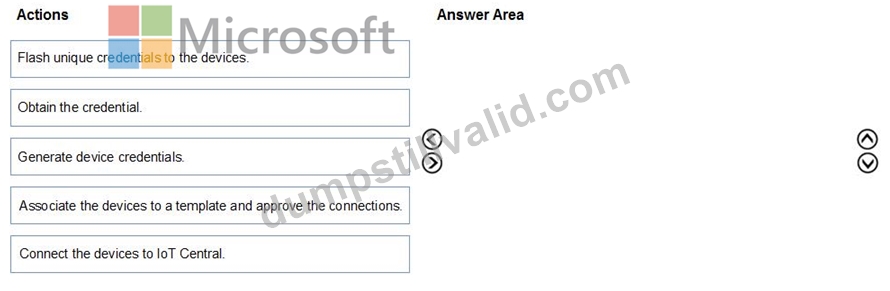
Answer:
Explanation: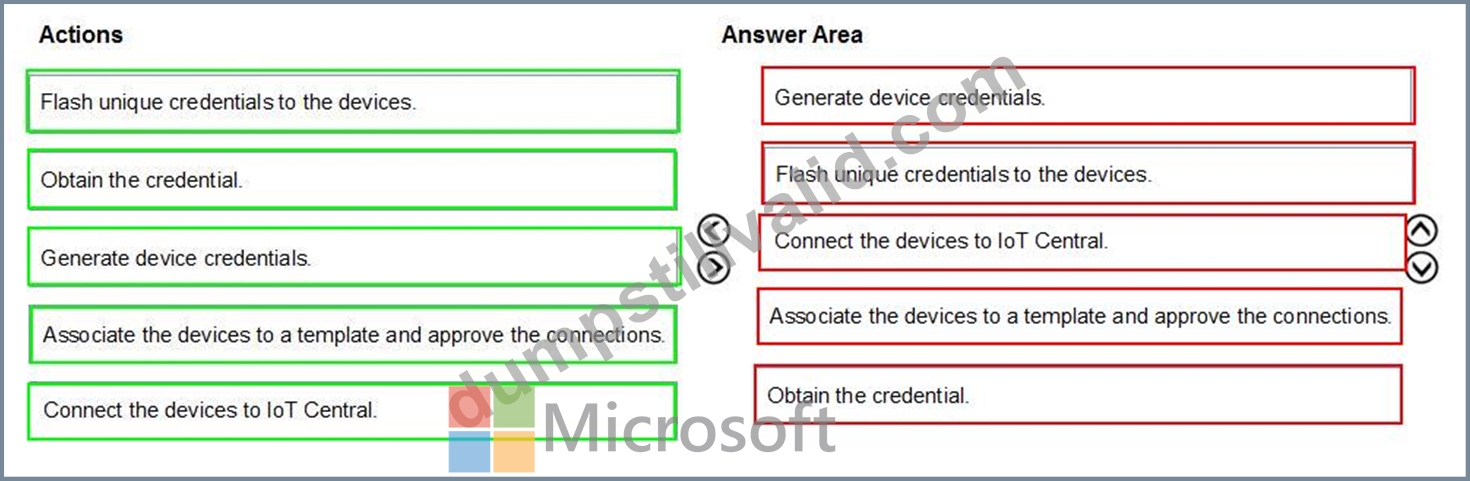
Explanation:
Step: With DPS (Device Provisioning Service) you can generate device credentials and configure the devices offline without registering the devices through IoT Central UI.
Connect devices that use SAS tokens without registering
1. Copy the IoT Central application's group primary key
2. Use the dps-keygen tool to generate the device SAS keys. Use the group primary key from the previous step. The device IDs must be lower-case:
dps-keygen -mk:<group primary key> -di:<device ID>
3. The OEM flashes each device with a device ID, a generated device SAS key, and the application ID scope value.
4. When you switch on a device, it first connects to DPS to retrieve its IoT Central registration information.
The device initially has a device status Unassociated on the Devices page and isn't assigned to a device template. On the Devices page, Migrate the device to the appropriate device template. Device provisioning is now complete, the device status is now Provisioned, and the device can start sending data.
On the Administration > Device connection page, the Auto approve option controls whether you need to manually approve the device before it can start sending data.
Reference:
https://docs.microsoft.com/en-us/azure/iot-central/core/concepts-get-connected
NEW QUESTION 69
During the POV phase, telemetry from IoT Hub stops flowing to the hot path. The cold path continues to work.
What should you do to restore the hot path?
- A. Run the Test all routes action.
- B. Modify cold-route to send only some telemetry data to the cold path.
- C. Disable the fallback route.
- D. Create an explicit route for the hot path.
Answer: D
NEW QUESTION 70
You have an Azure IoT solution that includes several Azure IoT hubs.
A new alerting feature was recently added to the IoT devices. The feature uses a new device twin reported property named alertCondition.
You need to send alerts to an Azure Service Bus queue named MessageAlerts. The alerts must include alertConditionand the name of the IoT hub.
Which two actions should you perform? Each correct answer presents part of the solution.
NOTE: Each correct selection is worth one point.
- A. Add the following message enrichments:
Name = iotHubName
Value = $twin.tag.location
Endpoint = MessageAlert - B. Configure File upload for each IoT hub. Configure the device to send a file to an Azure Storage container that contains the device name and status message.
- C. Add the following message enrichments:
Name = iotHubName
Value = $iothubname
Endpoint = MessageAlert - D. Create an IoT Hub routing rule that has a data source of Device Telemetry Messages and select the endpoint for MessageAlerts.
- E. Create an IoT Hub routing rule that has a data source of Device Twin Change Events and select the endpoint for MessageAlerts.
Answer: A,C
Explanation:
B: Message enrichments is the ability of the IoT Hub to stamp messages with additional information before the messages are sent to the designated endpoint. One reason to use message enrichments is to include data that can be used to simplify downstream processing. For example, enriching device telemetry messages with a device twin tag can reduce load on customers to make device twin API calls for this information.
D: Applying enrichments
The messages can come from any data source supported by IoT Hub message routing, including the following examples:
* -->device twin change notifications -- changes in the device twin
* device telemetry, such as temperature or pressure
* device life-cycle events, such as when the device is created or deleted Reference:
https://docs.microsoft.com/en-us/azure/iot-hub/iot-hub-message-enrichments-overview
NEW QUESTION 71
You have 10,000 IoT devices that connect to an Azure IoT hub. The devices do not support over-the-air (OTA) updates.
You need to decommission 1,000 devices. The solution must prevent connections and autoenrollment for the decommissioned devices.
Which two actions should you perform? Each correct answer presents part of the solution.
NOTE: Each correct selection is worth one point.
- A. Blacklist the X.509 root certification authority (CA) certificate for the enrollment group.
- B. Remove the identity certificate from the hardware security module (HSM) of the devices.
- C. Delete the device identity from the device registry of the IoT hub.
- D. Delete the enrollment entry for the devices.
- E. Update the connectionState device twin property on all the devices.
Answer: C,D
Explanation:
In general, deprovisioning a device involves two steps:
* Disenroll the device from your provisioning service, to prevent future auto-provisioning. Depending on whether you want to revoke access temporarily or permanently, you may want to either disable or delete an enrollment entry.
* Deregister the device from your IoT Hub, to prevent future communications and data transfer. Again, you can temporarily disable or permanently delete the device's entry in the identity registry for the IoT Hub where it was provisioned.
Reference:
https://docs.microsoft.com/en-us/azure/iot-dps/how-to-unprovision-devices
NEW QUESTION 72
Note: This question is part of a series of questions that present the same scenario. Each question in the series contains a unique solution that might meet the stated goals. Some question sets might have more than one correct solution, while others might not have a correct solution.
After you answer a question in this section, you will NOT be able to return to it. As a result, these questions will not appear in the review screen.
You have an Azure Stream Analytics job that receives input from an Azure IoT hub and sends the outputs to Azure Blob storage. The job has compatibility level 1.1 and six streaming units.
You have the following query for the job.
You plan to increase the streaming unit count to 12.
You need to optimize the job to take advantage of the additional streaming units and increase the throughput.
Solution: You change the query to the following.
Does this meet the goal?
- A. No
- B. Yes
Answer: A
Explanation:
Max number of Streaming Units with one step and with no partitions is 6.
Reference:
https://docs.microsoft.com/en-us/azure/stream-analytics/stream-analytics-parallelization
NEW QUESTION 73
......
Step by Step Guide to Prepare for AZ-220 Exam: https://www.dumpstillvalid.com/AZ-220-prep4sure-review.html
