


FCP_GCS_AD-7.6 exam questions for practice in 2026 Updated 37 Questions
Updated Jun-2026 Premium FCP_GCS_AD-7.6 Exam Engine pdf - Download Free Updated 37 Questions
NEW QUESTION # 21
Your organization is deciding between deploying FortiGate active-passive high-availability (HA) in Google Cloud using either the software-defined network (SDN) connector or load balancers.
What two reasons should your organization choose the SDN connector over the load balancer deployment?
(Choose two.)
- A. The SDN connector supports multizone failover.
- B. Failovers are faster because of to API calls.
- C. Cost is lower.
- D. There isess administrative overhead.
Answer: C,D
Explanation:
Using the SDN connector avoids additional load balancer costs, making it more cost-effective.
The SDN connector enables multizone failover by directly managing network routing, which load balancers do not inherently support.
NEW QUESTION # 22
An organization is deploying an active-passive high availability (HA) cluster using passthrough load balancers in Google Cloud.
What is a critical factor for ensuring successful HA formation, failover, and traffic flow?
- A. Unicast FortiGate Clustering Protocol (FGCP) must be used.
- B. Incoming traffic must be source NATed to ensure traffic flow symmetry.
- C. VDOM exceptions must be configured.
- D. There can be more than two cluster members.
Answer: B
Explanation:
Source NAT ensures that traffic is symmetric by keeping the source IP consistent, which is critical for proper failover and session synchronization in an active-passive HA cluster using passthrough load balancers.
NEW QUESTION # 23
Your organization has decided to deploy a high-availability (HA) cluster. One kye requirement of the deployment is to support configuration synchronization.
Which three deployment types should be considered? (Choose three.)
- A. Active-passive HA using software-defined networking (SDN)
- B. Active-active HA using auto scaling
- C. Active-passive HA using FGSP
- D. Active-passive HA using passthrough load balancers
Answer: A,C,D
Explanation:
These three deployment types support configuration synchronization between HA cluster members, which is critical for maintaining consistent state and seamless failover.
NEW QUESTION # 24
Refer to the exhibit.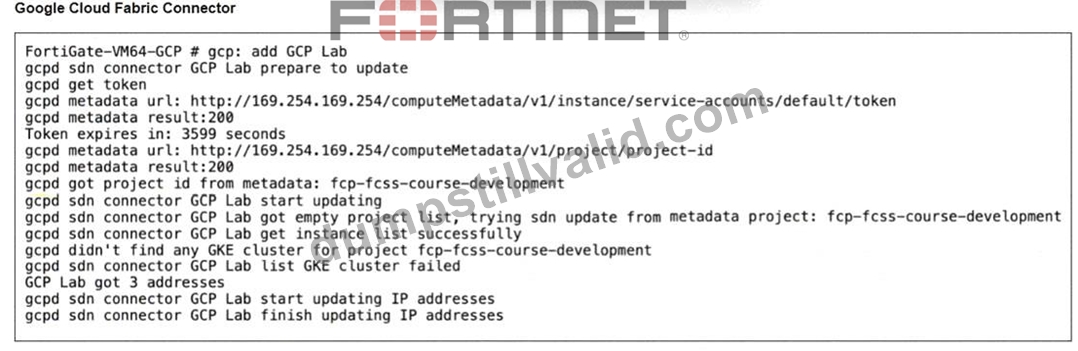
An administrator configured GoogleCloud as an external fabric connector on FortiGate.
Which conclusion can you draw from the output?
- A. The external fabric connector is misconfigured.
- B. The external fabric connector is unable to find a valid Google Cloud project.
- C. The external fabric connector shows that an administrator created three dynamic firewall addresses.
- D. The external fabric connector found multiple IP addresses assigned to Google Cloud instances.
Answer: D
Explanation:
The output shows the connector successfully retrieved project information and instance IP addresses (GCP Lab got 3 addresses), indicating it found multiple IPs assigned to Google Cloud instances.
NEW QUESTION # 25
Which Fortinet proprietary protocol do you use when deploying an active-passive high-availability (HA) cluster in Google Cloud?
- A. Multicast FGSP
- B. Unicast FGCP
- C. Broadcast FGCP
- D. Anycast FGSP
Answer: B
Explanation:
Unicast FGCP (FortiGate Clustering Protocol) is the proprietary protocol used for active-passive HA clusters in Google Cloud, enabling state synchronization and failover communication between cluster members.
NEW QUESTION # 26
Your organization is deciding between deploying FortiGate active-passive high-availability (HA) in Google Cloud using either the software-defined network (SDN) connector or load balancers.
What two reasons should your organization choose the SDN connector over the load balancer deployment?
(Choose two.)
- A. The SDN connector supports multizone failover.
- B. Failovers are faster because of to API calls.
- C. Cost is lower.
- D. There isess administrative overhead.
Answer: C,D
Explanation:
Using the SDN connector avoids additional load balancer costs, making it more cost-effective.
The SDN connector enables multizone failover by directly managing network routing, which load balancers do not inherently support.
NEW QUESTION # 27
An organization has decided to deploy an active-active high-availability cluster in Google Cloud.
Which three load balancing features are critical to the successful deployment of the cluster? (Choose three.)
- A. The L3_DEFAULT protocol in the forwarding rule of the internal passthrough network load balancer
- B. The session termination of the external passthrough network load balancer
- C. The health check used by the internal and the external passthrough network load balancer
- D. The forwarding rule for the internal passthrough network load balancer as the next hot for custom routes
- E. The symmetric hashing of the internal passthrough network load balancer
Answer: C,D,E
Explanation:
Health checks ensure load balancers route traffic only to healthy cluster members.
Forwarding rules act as next hops in routing, directing traffic appropriately within the HA cluster.
Symmetric hashing ensures consistent and balanced traffic distribution across cluster members, critical for active-active deployments.
NEW QUESTION # 28
You need to deploy a new Windows server in Google Cloud to offload web traffic from an existing web server in a different zone.
As the customer, which two actions must you take to secure the new ComputeEngine instance? (Choose two.)
- A. Implement a web application firewall.
- B. Configure Google Cloud IAM to limit Windows administrator access.
- C. Assign firewall rules to the compute engine instance.
- D. Change the proxy load balancer to an application load balancer.
Answer: B,C
Explanation:
Assigning firewall rules controls network traffic to the instance, protecting it from unauthorized access.
Configuring IAM to limit administrative access ensures only authorized users can manage the Windows server, enhancing security.
NEW QUESTION # 29
Refer to the exhibit.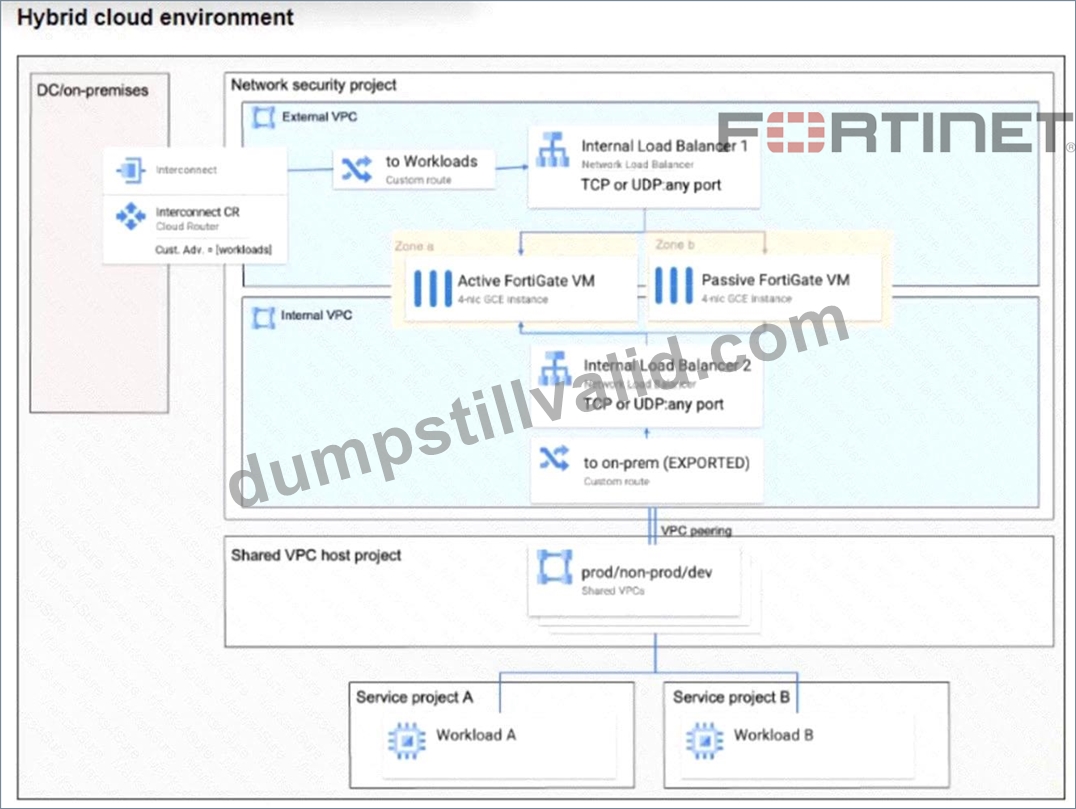
In this hybrid environment, in which two ways does the traffic flow from a network node in the on-premises network to Workload B in Google Cloud? (Choose two.)
- A. Traffic will be routed using VPC peering from the Internal VPC to the destination subnet.
- B. Traffic will not reach the FortiGate devices because both load balancers are internal.
- C. Once the traffic has been inspected, the active FortiGate uses VPC peering to forward the traffic to the Server project A VPC.
- D. When the packet reaches the external VPC, it is forwarded to the active FortiGate cluster member using a custom static route.
Answer: A,D
Explanation:
Traffic from on-premises enters the external VPC and is routed to the active FortiGate VM via custom routes for inspection.
After inspection, traffic is routed through VPC peering from the internal VPC to the service project subnet where Workload B resides.
NEW QUESTION # 30
An administrator configured an external fabric connector for Google Cloud to pull information from Google Cloud, including addresses, VM names, and subnets to create firewall policies.
When trying to create dynamic firewall addresses, the list of available instances does not populate any information from Google Cloud.
Which two issues are the most probable cause? (Choose two.)
- A. Google Cloud Metadata API access is disabled for Compute Engine for the FortiGate instance.
- B. There are no VM instances deployed in Google Cloud.
- C. The VM instances in Google Cloud have multiple IP address assigned to them.
- D. The VM instances in Google Cloud were not deployed using Google Cloud marketplace.
Answer: A,B
Explanation:
The external fabric connector relies on Google Cloud Metadata API access to retrieve instance information; if this is disabled, data won't populate.
If no VM instances exist in the project, there will be no instance data for the connector to retrieve.
NEW QUESTION # 31
Refer to the exhibit.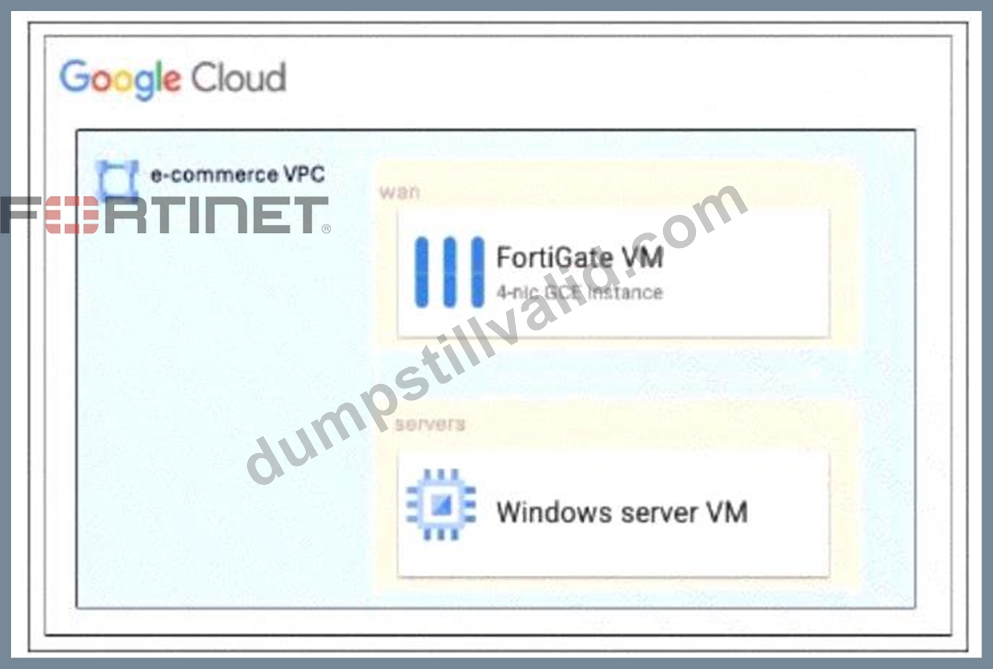
An administrator is troubleshooting network connectivity issues between two VMs deployed in Google Cloud.
One VM is a FortiGate located in the subnet "wan" that is part of the VPC "e-commerce". The other VM is a Windows server located in subnet "servers", which is also in the "e-commerce" VPC.
What are two reasons you cannot pint the Windows server from FortiGate? (Choose two.)
- A. Add a Google Cloud firewall rule to allow ICMP traffic inbound to the Windows firewall VM.
- B. ICMP traffic is blocked between Google Cloud subnets by default.
- C. The default Google Cloud firewall policy does not allow this traffic.
- D. The Windows firewall is blocking the traffic.
Answer: A,D
Explanation:
Google Cloud firewall rules are stateful and, by default, do not allow ICMP traffic; you must explicitly allow ICMP inbound traffic to the Windows VM.
The Windows VM's own firewall might block ICMP traffic, preventing ping responses.
NEW QUESTION # 32
An administrator is tasked to deploy two FortiGate devices in two different zoned to achieve geographical redundancy.
Which two architectural considerations must the administrator address? (Choose two.)
- A. The FortiGate devices must not be deployed in the same VPC.
- B. The FortiGate devices must be deployed in two different regions.
- C. The FortiGate devices cannot be assigned the second IP address in the subnets that they are deployed in.
- D. The FortiGate devices can be deployed in the same subnet.
Answer: B,C
Explanation:
Deploying FortiGate devices in different regions ensures geographic redundancy.
The second IP address in a subnet is reserved for the default gateway in Google Cloud, so FortiGate devices cannot use that IP.
NEW QUESTION # 33
Your organization is running an application in their shared services virtual public cloud (VPC) and must control network access natively in the cloud.
How can your organization meet this requirement?
- A. Create a firewall rule that allows access to the application instance only.
- B. Create a firewall policy for the entire VPC that allows access from all networks.
- C. Create another VPC in front of the shared services VPC and deploy FortiGate.
- D. Create IAM access to allow access from specified resources only.
Answer: A
Explanation:
Creating specific firewall rules that restrict access directly to the application instance allows precise native network access control within the shared services VPC.
NEW QUESTION # 34
Google Cloud network services offer vast functionality and inter-connectivity between the cloud and on- premises networks.
Which three additional functions does FortiGate offer when deployed in Google Cloud to complement the native services offered by Google Cloud? (Choose three.)
- A. Secure SD-WAN with application visibility
- B. OSPF over IPSec
- C. SSL VPN
- D. SSL inspection
- E. Web filtering
Answer: A,C,D
Explanation:
FortiGate provides SSL VPN capabilities for secure remote access.
It offers SSL inspection to decrypt and inspect encrypted traffic for threats.
FortiGate supports Secure SD-WAN with deep application visibility and control, enhancing network performance and security beyond native Google Cloud services.
NEW QUESTION # 35
A cloud administrator has been receiving reports of slow response times from users accessing their organization's web application, which is protected by FortiWeb Cloud.
Which two steps can be taken to potentially alleviate the problem? (Choose two.)
- A. Adding additional passthrough load balancers.
- B. Enabling the content delivery network (CDN).
- C. Changing the DNS records to point to the web application.
- D. Deploying FortiWeb Cloud in the same region where the web application is hosted.
Answer: B,D
Explanation:
Deploying FortiWeb Cloud closer to the web application reduces latency and improves response times.
Enabling CDN caches content closer to users, reducing load times and speeding up content delivery.
NEW QUESTION # 36
......
Authentic FCP_GCS_AD-7.6 Dumps With 100% Passing Rate Practice Tests Dumps: https://www.dumpstillvalid.com/FCP_GCS_AD-7.6-prep4sure-review.html
Fortinet FCP_GCS_AD-7.6 Real Exam Questions Guaranteed Updated Dump from DumpStillValid: https://drive.google.com/open?id=1XfvP0-MOnSNrd2vcjU1TbhkDMpetpMg7
