


In 2026, consistency beats cramming, and daily review of your own mistakes is the most consistent habit there is. DumpStillValid makes that habit easy for the 300-215 exam with 187 practice questions and an engine that keeps your weak spots in front of you.
Cisco 300-215 Exam Overview:
| Certification Vendor: | Cisco |
|---|---|
| Exam Name: | Conducting Forensic Analysis & Incident Response Using Cisco Technologies for CyberOps |
| Exam Number: | 300-215 |
| Available Languages: | English |
| Exam Duration: | 90 minutes |
| Exam Format: | Multiple choice, Drag-and-drop, Performance-based items |
| Real Exam Qty: | 60–75 |
| Certificate Validity Period: | 3 years |
| Passing Score: | 825 / 1000 |
| Exam Price: | USD 300 |
| Related Certifications: | Cisco Certified Specialist – Cybersecurity Forensic Analysis and Incident Response CCNP Cybersecurity |
| Recommended Training: | Conducting Forensic Analysis and Incident Response Using Cisco Technologies for Cybersecurity |
| Exam Registration: | Pearson VUE Registration |
| Sample Questions: |  |
| Exam Way: | Online proctored or onsite at Pearson VUE test centers |
| Pre Condition: | No formal prerequisites; recommended: 2–3 years of experience in SOC environment, familiarity with security concepts, tools, and log analysis |
| Official Syllabus URL: | https://www.cisco.com/site/us/en/learn/training-certifications/exams/cbrfir.html |
Cisco 300-215 Exam Syllabus Topics:
| Section | Weight | Objectives |
|---|---|---|
| Incident Response Techniques | 30% | - Interpreting alerts from SIEM, IDS/IPS, syslog - Correlating host and network activity data - Response to zero-day exploits and vulnerabilities - Threat intelligence interpretation: IOCs, IOAs, actor profiling - Cisco security solutions for detection and prevention - Post-incident analysis and improvement actions - Attack vector analysis and mitigation recommendations |
| Malware Analysis | 15% | - Malware family and campaign identification - Malware classification and behavior analysis - Static and dynamic malware analysis - Reverse engineering principles |
| Forensics Techniques | 20% | - Forensic tools: Volatility, Sysinternals, SIFT, TCPdump - MITRE ATT&CK framework for fileless malware analysis - Script analysis (Python, PowerShell, Bash) for log processing - Host-based evidence location and collection - Identifying Indicators of Compromise (IOC) from tools output |
| Fundamentals | 20% | - Root cause analysis reporting components - YARA rules for malware identification and classification - Antiforensic tactics, techniques, and procedures - Encoding and obfuscation techniques - Evidence collection in virtualized environments - Network infrastructure device forensics |
| Forensics Processes | 15% | - Data acquisition: memory, disk, network - Evidence handling and chain of custody - Antiforensic techniques: debugging, geolocation, obfuscation - Legal and compliance considerations |
Practicing for the Cisco Conducting Forensic Analysis & Incident Response Using Cisco Technologies for CyberOps Exam: FAQ
After each practice session, the online test engine records which questions you answered incorrectly and reminds you to revisit them in your next round. Reviewing your own mistakes daily shows you clearly where your weaknesses and strengths lie, so every session builds on the last instead of starting from scratch.
The Cisco Conducting Forensic Analysis & Incident Response Using Cisco Technologies for CyberOps exam contains 60–75 questions, and you will have 90 minutes minutes to complete them. Practicing the full volume under a timer is the closest thing to rehearsing the real exam.
Many candidates combine practice questions with official training. Recommended options include:
Yes. The online test engine lets you set a time limit for each practice session, so you can train yourself to allocate minutes per question the way you will need to in the real 300-215 exam. Working under a clock at home makes time pressure on exam day feel routine rather than alarming.
The Cisco Conducting Forensic Analysis & Incident Response Using Cisco Technologies for CyberOps exam requires a score of 825 / 1000 to pass, and the official registration fee is USD 300. Since the exam fee is a real investment, thorough preparation is the most practical way to protect it.
No formal prerequisites; recommended: 2–3 years of experience in SOC environment, familiarity with security concepts, tools, and log analysis
You can confirm the current eligibility requirements on the official 300-215 exam page before you register.
The Cisco Conducting Forensic Analysis & Incident Response Using Cisco Technologies for CyberOps practice questions are organized around the official exam objectives. Key topics include:
- Malware Analysis (15%)
- Fundamentals (20%)
- Forensics Processes (15%)
Daily practice mapped to these topics keeps your preparation balanced across the whole syllabus.
You can register for the Cisco Conducting Forensic Analysis & Incident Response Using Cisco Technologies for CyberOps exam through the official channels:
This package includes 187 practice questions for the Cisco Conducting Forensic Analysis & Incident Response Using Cisco Technologies for CyberOps exam. Every answer is verified by an experienced team of experts, so you can trust what you study.
Cisco Conducting Forensic Analysis & Incident Response Using Cisco Technologies for CyberOps Sample Questions:
A network host is infected with malware by an attacker who uses the host to make calls for files and shuttle traffic to bots. This attack went undetected and resulted in a significant loss. The organization wants to ensure this does not happen in the future and needs a security solution that will generate alerts when command and control communication from an infected device is detected. Which network security solution should be recommended?
- A. Cisco Secure Web Appliance (WSA)
- B. Cisco Secure Email Gateway (ESA)
- C. Cisco Secure Firewall Threat Defense (Firepower)
- D. Cisco Secure Firewall ASA
Correct Answer: C 🗳️
Explanation: Only visible for DumpStillValid members. You can sign-up / login (it's free).
A cybersecurity analyst must identify an unknown service causing high CPU on a Windows server. What tool should be used?
- A. Volatility to analyze memory dumps for forensic investigation
- B. SIFT (SANS Investigative Forensic Toolkit) for comprehensive digital forensics
- C. TCPdump to capture and analyze network packets
- D. Process Explorer from the Sysinternals Suite to monitor and examine active processes
Correct Answer: D 🗳️
Refer to the exhibit.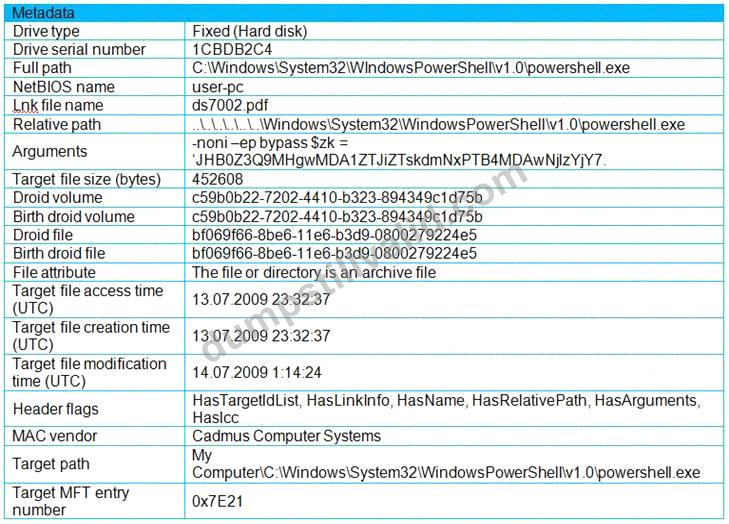
An engineer is analyzing a .LNK (shortcut) file recently received as an email attachment and blocked by email security as suspicious. What is the next step an engineer should take?
- A. Open the file in a sandbox environment for further behavioral analysis as the file contains a malicious script that runs on execution.
- B. Upload the file to a virus checking engine to compare with well-known viruses as the file is a virus disguised as a legitimate extension.
- C. Delete the suspicious email with the attachment as the file is a shortcut extension and does not represent any threat.
- D. Quarantine the file within the endpoint antivirus solution as the file is a ransomware which will encrypt the documents of a victim.
Correct Answer: A 🗳️
Explanation: Only visible for DumpStillValid members. You can sign-up / login (it's free).
A security team is discussing lessons learned and suggesting process changes after a security breach incident.
During the incident, members of the security team failed to report the abnormal system activity due to a high project workload. Additionally, when the incident was identified, the response took six hours due to management being unavailable to provide the approvals needed. Which two steps will prevent these issues from occurring in the future? (Choose two.)
- A. Introduce a priority rating for incident response workloads.
- B. Provide phishing awareness training for the full security team.
- C. Automate security alert timeframes with escalation triggers.
- D. Conduct a risk audit of the incident response workflow.
- E. Create an executive team delegation plan.
Correct Answer: A,E 🗳️
Explanation: Only visible for DumpStillValid members. You can sign-up / login (it's free).
Refer to the exhibit.
A web hosting company analyst is analyzing the latest traffic because there was a 20% spike in server CPU usage recently. After correlating the logs, the problem seems to be related to the bad actor activities. Which attack vector is used and what mitigation can the analyst suggest?
- A. Brute-force attack; implement account lockout policies and roll out MFA.
- B. Distributed denial of service; use rate limiting and DDoS protection services.
- C. Phishing attack; conduct regular user training and use email filtering solutions.
- D. SQL Injection; implement input validation and use parameterized queries.
Correct Answer: A 🗳️
Explanation: Only visible for DumpStillValid members. You can sign-up / login (it's free).
Viewing page 1 out of 38 pages.
Viewing questions 1-5 out of 187 questions.


 Mabel

 Alger
 Jonas

 Evelyn
 Ronald
 Maggie
 Cleveland
 Salome
 Beacher
 Mick

 Miles
 Buck
 Owen
 Myrna
 Nathaniel
 Ralap
 Kim


