


Learning by doing beats learning by rereading. The DumpStillValid engines turn Microsoft Designing Business Intelligence Solutions with Microsoft SQL Server preparation into active exercise, so the 070-467 material impresses itself into memory instead of sliding off it.
Microsoft 070-467 Exam Overview:
| Certification Vendor: | Microsoft |
|---|---|
| Exam Name: | Designing Business Intelligence Solutions with Microsoft SQL Server |
| Exam Number: | 70-467 |
| Exam Format: | Multiple answer, Case study / scenario questions, Multiple choice |
| Exam Price: | $165 USD (guide historic list price; may vary by region) |
| Certificate Validity Period: | Retired (no longer available for new certification as of Jan 31, 2021) |
| Exam Duration: | 120 minutes |
| Available Languages: | English, Japanese (localized exam available) |
| Real Exam Qty: | 45–55+ (multiple choice, scenario-based) |
| Related Certifications: | 70-466 Implementing Data Models and Reports with Microsoft SQL Server 70-463 Implementing a Data Warehouse with Microsoft SQL Server MCSE: Data Management & Analytics |
| Passing Score: | 700 (scaled scoring) |
| Sample Questions: |  |
| Exam Way: | Previously delivered through Pearson VUE as onsite or online proctored exam |
| Pre Condition: | Recommended experience with SQL Server BI stack (SSIS, SSAS, SSRS) and data warehousing concepts |
| Official Syllabus URL: | https://learn.microsoft.com/en-us/certifications/exams/70-467 |
Microsoft 070-467 Exam Syllabus Topics:
| Section | Weight | Objectives |
|---|---|---|
| Design Data Acquisition and Data Models | - Determine data movement and profiling strategies - Identify data sources and dependencies - Design data warehouse schemas and analytical data models | |
| Manage Reporting Services Configuration | - Plan reporting services configuration (native vs SharePoint) - Configure data refresh schedules (PowerPivot/SharePoint) | |
| Design a Reporting Solution | 20–25% | - Design Reporting Services datasets and parameters - Install/configure Power View and PowerPivot integration - Design report delivery and migration strategies - Manage Excel Services and SharePoint BI reporting |
| Plan Business Intelligence (BI) Infrastructure | 15–20% | - Plan and manage upgrades - Plan for scalability and storage options (MOLAP/ROLAP/HOLAP) - Plan for performance (ETL optimization, SSAS/MDX/DAX performance) - Maintain server health and automation strategy |
| Design BI Infrastructure | 15–20% | - Design high availability and disaster recovery - Design security strategy and impersonation configurations - Design SQL partitioning strategy - Design logging and auditing strategies |
070-467 Exam Questions, Answered Without the Hype
Microsoft Designing Business Intelligence Solutions with Microsoft SQL Server is an official Microsoft exam, catalogued under the code 070-467. Passing it earns you the Microsoft SQL Server 2012 certification at the Professional / Expert (historically part of MCSE) level. It also connects with MCSE: Data Management & Analytics, 70-466 Implementing Data Models and Reports with Microsoft SQL Server, 70-463 Implementing a Data Warehouse with Microsoft SQL Server. The credential carries the vendor's authority, which is why it keeps opening doors for the people who hold it.
Yes, and for every version. DumpStillValid provides free demos of the Microsoft Designing Business Intelligence Solutions with Microsoft SQL Server material so you can compare the PDF, SOFT, and online formats before deciding. After purchase, updates are free for 365 days, and when your product expires you can extend the update service at a 50% discount.
Microsoft Designing Business Intelligence Solutions with Microsoft SQL Server gives you 45–55+ (multiple choice, scenario-based) questions inside 120 minutes. Rather than cramming mechanically, rehearse the pace actively: the DumpStillValid SOFT engine teaches through timed exercises, so flagging, skipping, and returning become reflexes before exam day rather than improvisations during it.
Passing Microsoft Designing Business Intelligence Solutions with Microsoft SQL Server requires 700 (scaled scoring), and official registration costs $165 USD (guide historic list price; may vary by region). Since every retake bills the full $165 USD (guide historic list price; may vary by region) again, the sensible sequence is practice first, book second. When your DumpStillValid practice scores clear the requirement across repeated sessions, the exam stops being a gamble.
Recommended experience with SQL Server BI stack (SSIS, SSAS, SSRS) and data warehousing concepts
Vendor rules change over time, so confirm the current conditions before registering on the official exam page.
A 100% money-back guarantee covers you under stated conditions. Take the Microsoft Designing Business Intelligence Solutions with Microsoft SQL Server exam within 60 days of purchase; if you fail, you may claim a full refund, provided the exam matches your product. Attempts within 3 days of purchase are ineligible, as are downloaded-but-unused products, free materials, and expired orders; the candidate name must match the payer name. Submit a scanned enrollment slip and the official Score Report PDF within 2 days of the exam, and claims are processed within 7 days. You may instead exchange for two other exam products of equal value, free, keeping the update service on your original purchase.
Delivery is safe and fast: payment runs through a secure environment, files unlock for download at once, and everything is emailed to you within one minute. If nothing arrives within 2 hours, check spam and consult our online service. Installation is unlimited across your computers.
Microsoft Designing Business Intelligence Solutions with Microsoft SQL Server is divided into 5 official domains, led by Plan Business Intelligence (BI) Infrastructure (15–20%), Design BI Infrastructure (15–20%), and Manage Reporting Services Configuration. The complete breakdown is above on this page; candidates who study the syllabus first waste the least time later.
Microsoft Designing Business Intelligence Solutions with Microsoft SQL Server Sample Questions:
You need to implement the Customer Sales and Manufacturing data models.
What should you do? (Each correct answer presents a partial solution. Choose all that apply.)
- A. Use SQL Server Integration Services (SSIS) to copy the database design to the SSAS instance, and specify tabular mode as the destination.
- B. Use the Database Synchronization Wizard to upgrade the database to tabular mode.
- C. Install a new instance of SSAS in tabular mode.
- D. Use SQL Server Data Tools (SSDT) to redevelop and deploy the projects.
- E. Use the current SSAS instance.
Correct Answer: C,D 🗳️
Explanation: Only visible for DumpStillValid members. You can sign-up / login (it's free).
You are creating a Multidimensional Expressions (MDX) calculation for Projected Revenue in a cube.
For Product A, Projected Revenue is defined as 150 percent of the Total Sales of the product. For all other products, Projected Revenue is defined as 110 percent of the Total Sales of the product.
You need to calculate the Projected Revenue as efficiently as possible.
Which calculation should you use? (More than one answer choice may achieve the goal. Select the BEST answer.)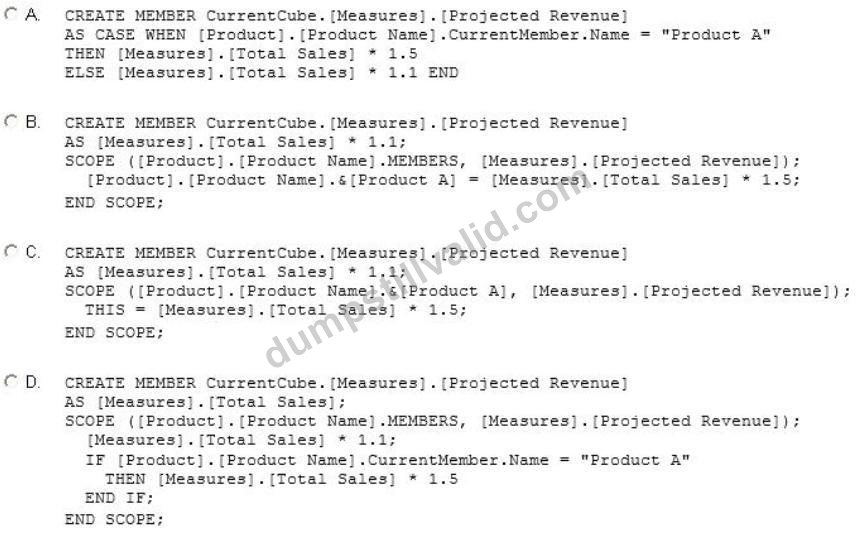
- A. Option B
- B. Option D
- C. Option A
- D. Option C
Correct Answer: D 🗳️
You are creating a SQL Server Integration Services (SSIS) package to populate a fact table from a source table. The fact table and source table are located in a SQL Azure database. The source table has a price field and a tax field. The OLE DB source uses the data access mode of Table.
You have the following requirements:
* The fact table must populate a column named TotalCost that computes the sum of the price and tax columns.
* Before the sum is calculated, any records that have a price of zero must be discarded.
You need to create the SSIS package in SQL Server Data Tools.
In what sequence should you order four of the listed components for the data flow task? (To answer, move the appropriate components from the list of components to the answer area and arrange them in the correct order.)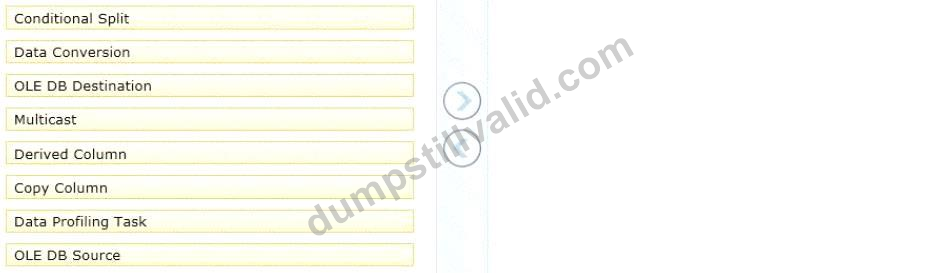
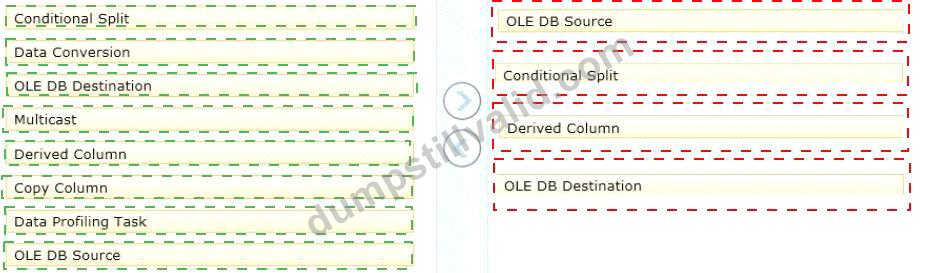
Correct Answer:
Explanation
Box 1: Ole DB Source
Box 2: Conditional Split
Disregard lines with a 0 sum.
Box 3: Derived column
Box 4: Ole DB Destination
Note:
* You configure a Data Flow task by adding components to the Data Flow tab. SSIS supports three types of data flow components:
Sources: Where the data comes from
Transformations: How you can modify the data
Destinations: Where you want to put the data
* Creating a data flow includes the following steps:
/ Adding one or more sources to extract data from files and databases, and add connection managers to connect to the sources.
/ Adding the transformations that meet the business requirements of the package. A data flow is not required to include transformations.
Some transformations require a connection manager. For example, the Lookup transformation uses a connection manager to connect to the database that contains the lookup data.
/ Connecting data flow components by connecting the output of sources and transformations to the input of transformations and destinations.
/ Adding one or more destinations to load data into data stores such as files and databases, and adding connection managers to connect to the data sources.
/ Configuring error outputs on components to handle problems.
At run time, row-level errors may occur when data flow components convert data, perform a lookup, or evaluate expressions. For example, a data column with a string value cannot be converted to an integer, or an expression tries to divide by zero. Both operations cause errors, and the rows that contain the errors can be processed separately using an error flow.
/ Include annotations to make the data flow self-documenting.
* The capabilities of transformations vary broadly. Transformations can perform tasks such as updating, summarizing, cleaning, merging, and distributing data. You can modify values in columns, look up values in tables, clean data, and aggregate column values.
* The Data Flow task encapsulates the data flow engine that moves data between sources and destinations, and lets the user transform, clean, and modify data as it is moved. Addition of a Data Flow task to a package control flow makes it possible for the package to extract, transform, and load data.
A data flow consists of at least one data flow component, but it is typically a set of connected data flow components: sources that extract data; transformations that modify, route, or summarize data; and destinations that load data.
You are designing a SQL Server Integration Services (SSIS) package configuration strategy.
The package configuration must meet the following requirements:
* Include multiple properties in a configuration.
* Support several packages with different configuration settings.
You need to select the appropriate configuration.
Which configuration type should you use?
To answer, select the appropriate option from the drop-down list in the dialog box.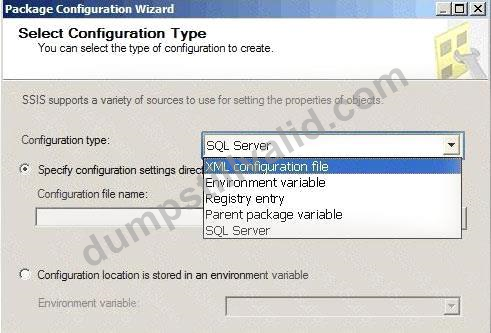
Correct Answer:
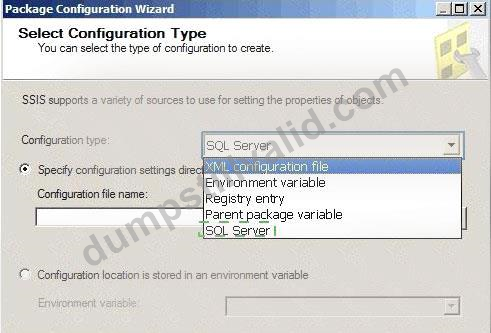
Explanation
Note:
Package Configuration Types
The following table describes the package configuration types.
* SQL Server table
A table in a SQL Server database contains the configuration. The table can include multiple configurations.
* XML configuration file
An XML file contains the configurations. The XML file can include multiple configurations.
* Environment variable
An environment variable contains the configuration.
* Registry entry
A Registry entry contains the configuration.
* Parent package variable
A variable in the package contains the configuration. This configuration type is typically used to update properties in child packages.
Reference: Package Configurations
The IT department is currently upgrading all SQL Server Integration Services (SSIS) packages to SSIS 2012.
The final version of a complex SSIS 2005 package has been overwritten. Four prior versions of the package exist. Each of the prior versions contains a different part of the final solution. You have backups of all associated project files.
You need to create an updated package as quickly and accurately as possible.
What should you do? (More than one answer choice may achieve the goal. Select the BEST answer.)
- A. Upgrade the four package versions. Use an XML editing tool to merge the compatible changes of the package versions by comparing the package refID fields.
- B. Upgrade the four package versions. Use SSIS Designer to visually compare the package versions, determine the compatible changes, and copy the compatible tasks into a single package.
- C. Use an XML editing tool to merge the compatible changes of the package versions by comparing the package refID fields. Upgrade the merged version.
- D. Use the DataSet.Merge method to merge the compatible changes of the package versions by using the Lineage IDs. Upgrade the merged version.
Correct Answer: A 🗳️
Viewing page 1 out of 37 pages.
Viewing questions 1-5 out of 185 questions.


 Agnes

 Steward

 Elvira

 Adela
 Aaron
 King
 Nydia
 Ingram
 Cheryl
 Hamiltion
 Verne
 Lambert
 Nicholas
 Dennis
 Bblythe
 Winifred
 Zoe
 Valerie


